CO with computed self-shielding against photodissociation
Warning This new option applies only to the developers' version. By default, including v2.0, the Bertoldi & Draine 1996 Astrophysical Journal v.458, p.222 DOI: 10.1086/176805 analytical self-shielding is used.
The CO photodissociation rate, self- and neutral Carbon- shielding against photodissociation can be calculated on the spot at each disk location. You need to enable the switch:
.true. ! CO_selfshielding_from_RTThe switch is .false. by default. The code calculated to photodissociation cross-section along two line-of-sights: one towards the star and one in the vertical direction. The cross-sections are calculated with the CO levels from the statistical equilibrium.
The CO electro/vibro-rotational population is assumed at LTE.
The following figures show the differences in CO photodissociation rates between the standard ProDiMo routine, the CO_selfshielding_from_RT routine, and the results from the paper by Visser et al. 2009 A&A 503, 323 for a unit Draine field The first figure is for a CO excitation temperature of 5K (0.3 km/s) and the second figure for 50K (0.3 km/s), and the third for 5K vturb=3 km/s.
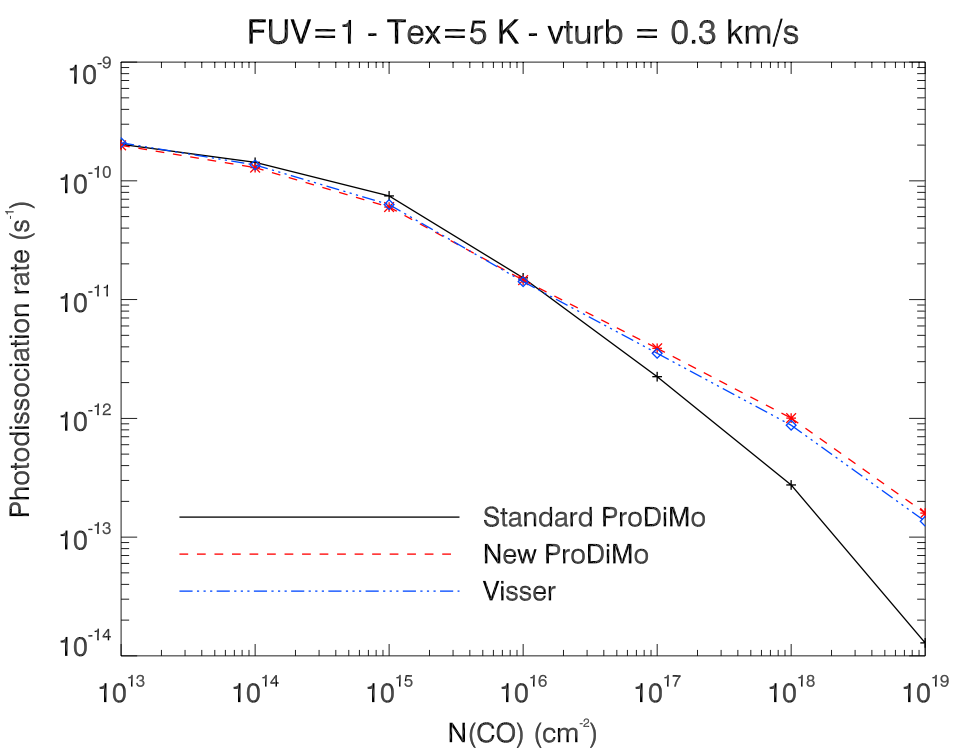
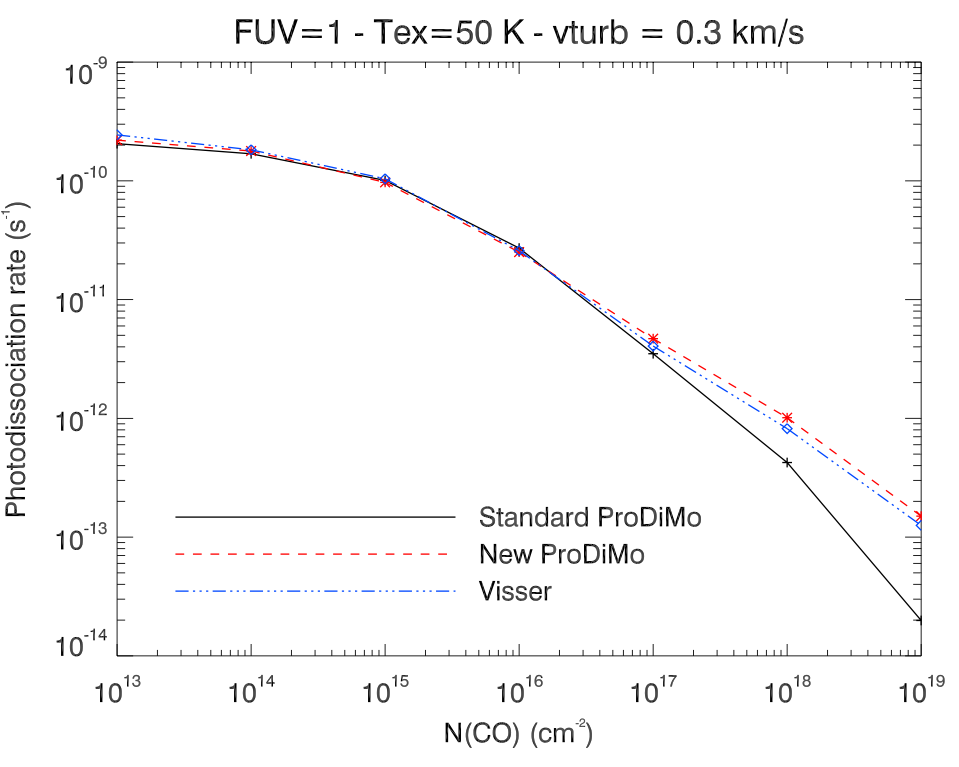
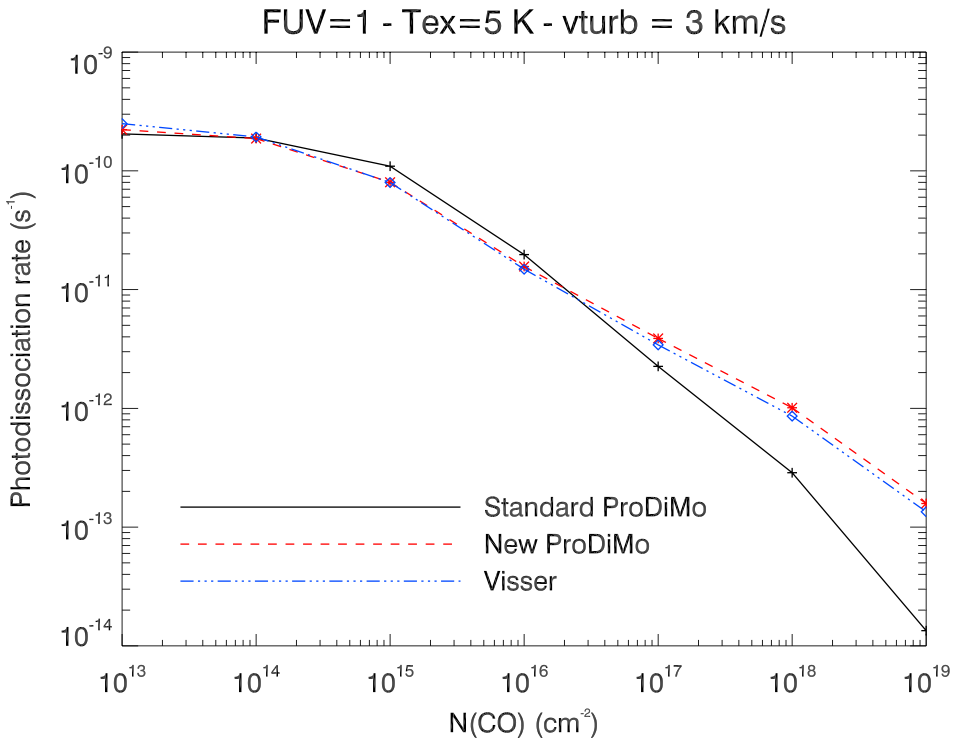
CO self-shielding and CO shielding by H2 is computed using a 1+1D line transfer.
There is no H2 self-shielding using line-by-line (not tested yet) even with the CO shielding flags on
Precomputed CO selfshielding
.true.        ! CO_selfshielding_from_RT
.true.        ! precomputed_CO_selfshielding
Both switches have to be set to true at the same time.
With the extra switch on, ProDiMio will try to read a table of precomputed cross-sections at various CO temperature for a give turbulence width. Otherwise the code will recompute the grid at the beginning of the run once. During the chemical-iteration, the code will interpolate the cross-sections. As a result the code is almost as fast as with the tabulated self-shielding factors. The CO levels are at v=0 in LTE if the precomputed_CO_selfshielding is switched on.
The 3656 absorption line data from the ground electronic and vibrational level of CO are taken from the Meudon group (PDR and spectroscopic group) database.
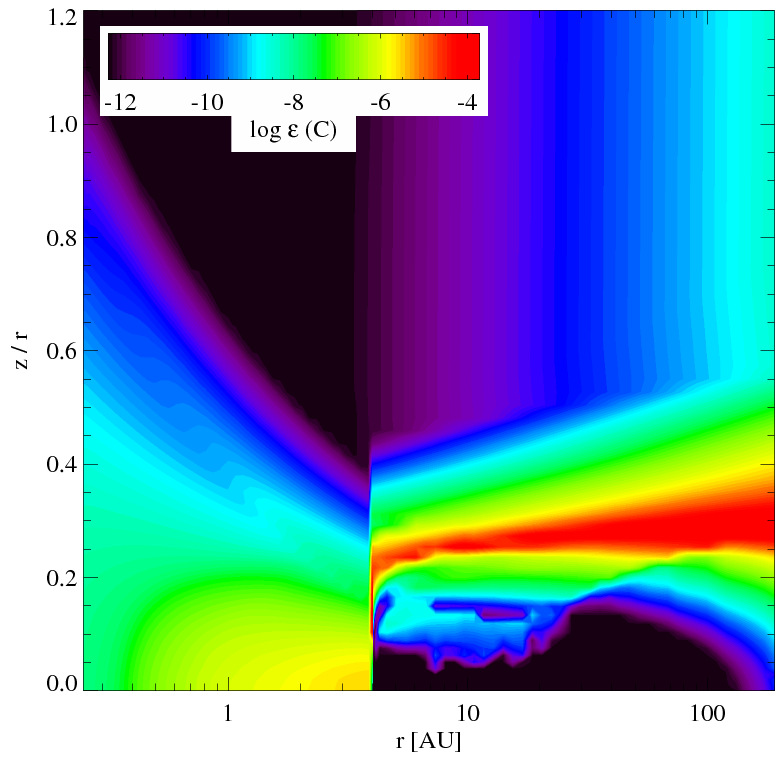
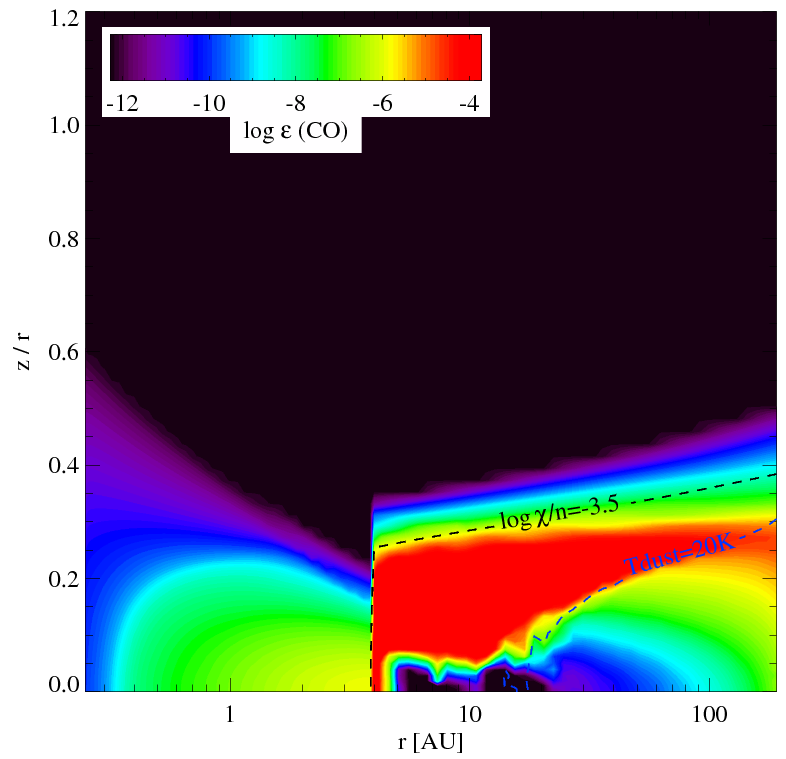
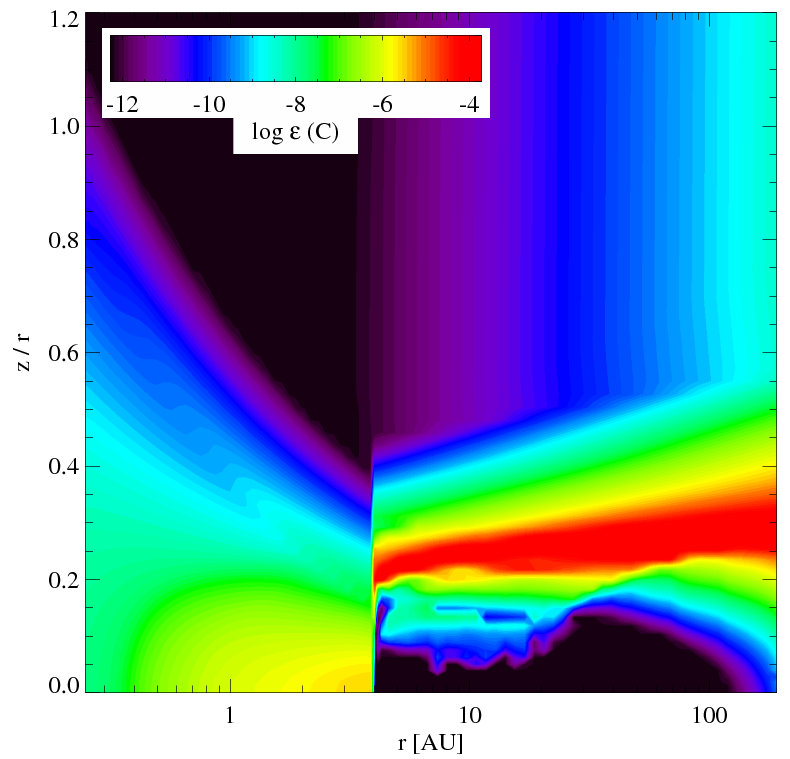
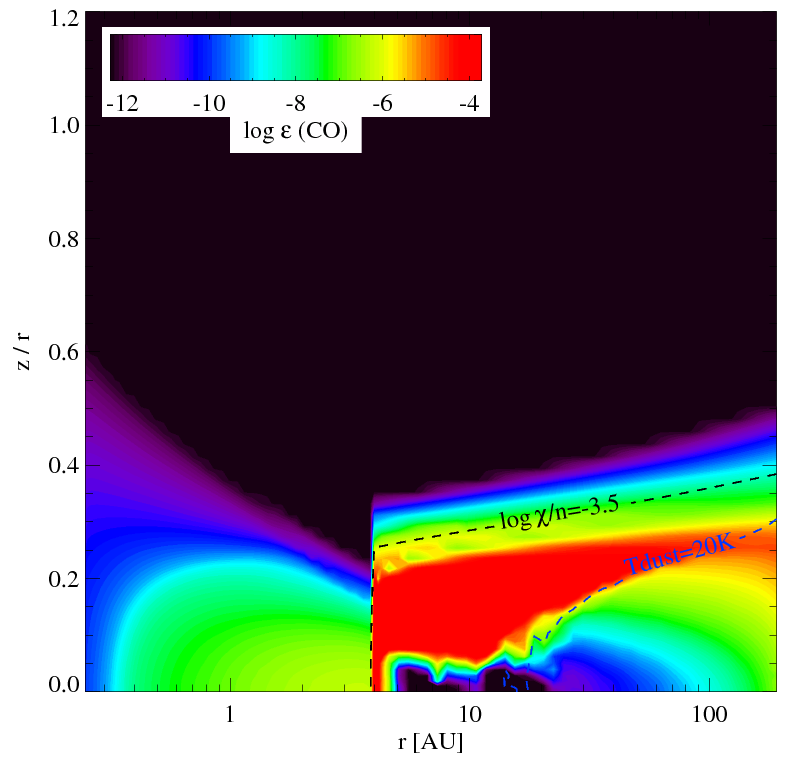
The CI/CO transition zone changes if one or the order of self/mutual-shielding method is used as you can see in the figures below.
Again the CO shielding by H2 is not accounted for.
The gas temperature grid is (Kelvin):
3.,5.,10.,15.,20.,30.,40.,50.,60.,70.,80.,90., 1e2,1.5e2,2e2,2.5e2,3e2,3.5e2,4e2,4.5e2, 5e2,5.5e2,6e2,6.5e2,7e2,7.5e2,8e2,8.5e2,9e2, 9.5e2,1e3,2e3,3e3,4e3,5e3,6e3,7e3,8e3,9e3,1e4, 2e4,3e4| Fig. 1 Neutral carbon relative abundance for the TWHya disk using standard CO self-shielding | Fig. 2 CO relative abundance using standard CO self-shielding |
|---|---|
 |
 |
| Fig. 3 Neutral carbon relative abundance for the TWHya disk using CO self-shielding computed from the local UV field | Fig. 4 CO relative abundance for the TWHya disk using CO self-shielding computed from the local UV field |
|---|---|
 |
 |
Precomputed H2-CO selfshielding
.true.        ! CO_selfshielding_from_RT
.true.        ! precomputed_H2_CO_selfshielding
Both switches have to be set to true at the same time. Here both the CO self- and by H2 shielding are computed by a line-by-line transfer in 1+1D. The first direction is toward the central object and the second direction is vertical.
The H2 self-shielding still uses an analytical implementation.