ProDiMo-MCFOST Interfaces
MCFOST to ProDiMo
WARNING: This document is likely outdated. Especially on the MCFOST side a lot has changed. It is currently unclear if the interface is still working.
ProDiMo can run in tandem with the code MCFOST (multidimensional Monte-Carlo radiative transfer code). You need to know how to run MCFOST, the ProDiMo developers do not maintain nor support the code MCFOST, please enquire Christophe Pinte. See also the MCFOST documentation.
The idea is to first model the dust by running MCFOST with the -prodimo option, which creates a interface data file for ProDiMo, and then to model the gas by running ProDiMo on top of that.
19/08/2013: The new MCFOST-ProDiMo interface transfers both the actual GAS density structure and the actual DUST density structure. Therefore the user has to re-run MCFOST each time that he/she changes the dust-to-gas mass ratio. The dust-to-gas is now a parameter in MCFOST that can be ProDiMo-zone dependent.
Step 1
When you run MCFOST in this modus, make sure to use the ProDiMo.lambda wavelength file in /mcfost/utils/Lambda/, and set the flag to use this (i.e. not the default MCFOST wavelength range). The corresponding section in the MCFOST input file should look like this:
#Grid geometry and size
  1                       1 = cylindrical, 2 = spherical
  100 80 1 20             n_rad, nz (or n_theta), n_az, n_rad_in
#Wavelength
  70  0.1 3000.0          n_lambda, min wl, max wl
  T T F                   compute temperature?, compute sed?, use default wavelength grid ?
  ProDiMo.lambda.         wavelength file (if previous parameter is F)
  F F                     separation of different contributions?, stokes parameters?
You can also use ProDiMo.lambda_UV1_3, ProDiMo.lambda_UV3_9, or ProDiMo.lambda_UV6_15, attached to this document, but then you need to link it to ProDiMo.lambda, because the -prodimo switch overrules your settings. It must be one of these grid files, otherwise ProDiMo will reject and stop, because we need to make sure that the lambda boundary values match with the definitions of the UV bands in ProDiMo.
The ProDiMo.lambda_UV1_3 can be safely used for a powerlaw-UV, however, if you have a steep or spiky, line-dominated UV, I'd recommend to use ProDiMo.lambda_UV6_15. Note that the file mcfost/utils/Lambda/ProDiMo.lambda has recently been changed. It should look like this:
     0.0942359
     0.1006141
     0.1074241
     0.1168222
     0.1293989
     0.1433296
     0.1587600
     0.1758515
     0.1947831
     0.2267423
     0.2773893
     0.3393494
     0.4151493
     0.5078805
     0.6213250
     0.7601094
     0.9298938
     1.1376028
     1.3917073
     1.7025708
     2.0828713
     2.5481190
     3.1172884
     3.8135922
     4.4361089
     4.9066020
     5.4269956
     6.0025820
     6.6392150
     7.3433693
     8.1222060
     8.9836461
     9.9364504
    10.9903090
    12.1559397
    13.4451970
    14.8711928
    16.4484296
    18.1929478
    20.1224894
    22.2566779
    24.6172182
    27.2281171
    30.1159275
    33.3100188
    36.8428749
    40.7504252
    45.0724099
    52.4298639
    64.1410401
    78.4681233
    95.9954246
   117.4377716
   143.6696620
   175.7609284
   215.0203705
   263.0491324
   321.8060034
   393.6873042
   481.6246182
   589.2043516
   720.8140008
   881.8210904
  1078.7920804
  1319.7601706
  1614.5529240
  1975.1930712
  2416.3888407
  2956.1338153
  3616.4407760
The number of photon packages should be quite large for the first MCFOST-phase, because we need smooth Tdust temperatures. I recommend
#Number of photon packages
  128       nbr_parallel_loop
  50000     nbr_photons_eq_th : T computation
Next, when you run MCFOST, make sure not to forget the -prodimo switch
./mcfost my_disc.para -prodimoThis will generate a file called forProDiMo.fits.gz in the data_th directory.
'''NOTE: You cannot combine -prodimo with -rt ! The ray-tracing SED results from MCFOST are incorrect if you use -prodimo. If you need -rt, you must run MCFOST twice, once with -rt to get the proper ray-traced SED, and once with -prodimo to get the proper forProDiMo.fits.gz.
Step 2
Go to the directory where you want to run ProDiMo, and copy forProDiMo.fits.gz here. Also copy sed2.fits.gz to that directory if you want to compare MCFOST's SED with the one calculated by ProDiMo based on the passed temperatures, mean intensities, and opacities (good safty-check).
Next, ensure that all the required *.in files needed by ProDiMo are present, typically Elements.in, LineTransferList.in, Parameter.in, Reactions.in and Species.in. At the moment, I would recommend to use the 3 input files provided in ~/ProDiMo/input_examples/Xrays+PAHs/developer.
In the Parameter.in file, specify the following input as follows:
0.25         ! Rin               : inner disk radius [AU]
300.0        ! Rout              : outer disk radius [AU]
0.01         ! dust_to_gas       : dust/gas mass ratio
0.1          ! fPAH              : PAH abundance with respect to ISM
70           ! NXX               : number of radial grid points
70           ! NZZ               : number of vertical grid points
.false.      ! solve_diskstruc   : solve the vertical hydrostatic eq.?
.true.       ! solve_temp        : solve the heating/cooling balance?
.false.      ! conserve_pressure : conserve pgas instead of n<H>?
.false.      ! restart           : restart from checkpoint file?
.false.      ! radtrans          : calculate dust continuum rad. transfer?
.true.       ! chi_from_RT       : calculate chi from UV rad. transfer?
.true.       ! Td_from_RT        : calculate dust temp. from rad. transfer?
.true.       ! Jback_from_RT     : calculate background Jnu from rad. transfer?
.true.       ! UVpumping         : use large model atoms?
.true.       ! PAH_from_RT       : PAH heating from cross-sections?
.true.       ! Rphoto_from_RT    : calculate photorates from rad. transfer?
.false.      ! Rphoto_bandint    : use band-integrated photo-rates?
------ mcfost ------
.false.      ! use_MCFOST_rgrid
.true.       ! readMCFOST
forProDiMo.fits.gz
------ image and SED parameters ------
.true.       ! calcSED            : calculate SED and images?
.true.       ! monoSED            : use monochromatic mode?
300          ! NlamSED            : number of lambda gridpoints
0.1          ! lminSED            : minimum lambda[mic]
3000.0       ! lmaxSED            : minimum lambda[mic]
140.0        ! dist      [pc]     : distance
30.0         ! incl      [deg]    : inclination (0=face-on)
------ line transfer? ------
.true.       ! line_transfer      : calculate line transfer?
Most of the other physical parameters, e.g. the stellar parameters, the dust size and opacity parameters, the dust settling and the disk shape parameters are meaningless, because they will be retrieved from forProDiMo.fits.gz and overwritten.
I recommend 30x30 grid for tests, 70x70 for serious models, and 100x100 for publications. The switch use_MCFOST_rgrid should be .false.. If this parameter is switched on, the r-gridpoints of MCFOST are taken over and the settings for NXX are ignored, however, Nzz still specifies the number of vertical grid points, creating a 100x70 grid in this case. However, the MCFOST grid is not very suitable for ProDiMo, in particular there are serious problems with mutli-zone models and use_MCFOST_rgrid=.true.
Rin and Rout should be the same than in the MCFOST parameter file.
radtrans=.false.: ProDiMo will not use it's own radiative transfer, instread the disk internal radiation field J_nu(r,z) and the dust temperature structure Tdust(r,z) are taken over from MCFOST. The radiation field can be noisy, in that case increase the number of photons in the MCFOST parameter file. The noise is stronger for optically thick disks. For test purposes, it is interesting to run with radtrans=.true., in which case ProDiMo will recompute the disk internal radiation field using MCFOST's dust opacities, and use Tdust and Jnu as initial guesses, however, remember that ProDiMo can only do isotropic scattering.
Rphoto_bandint=.false. debatable. If you have line-dominated UV input, one should use .true., however, if you model e.g. an A_star without excess UV, the interstellar hard UV will start to dominate at some radius, and then .true. will produce wrong results. If you have a strong powerlaw-UV, it shouldn't matter. Problem is that the spectral shape of the original stellar spectrum (+UV) should be the same on both sides MCFOST and ProDiMo, and the way to average bands should be the same, too, but this is not guaranteed at the moment (would need more testing). Therefore, I'd recommend Rphoto_bandint=.false. at the moment.
calcSED=.true. will re-calculate the SED using ProDiMo's raytracing code. This takes about 40sec, but provides an inportant sanity check. The SEDs of MCFOST and ProDiMo should look very similar in that case, in particular if you specify "-isotropic" for your MCFOST run. If you see large differences, it means that something went wrong - probably in the way the gridpoints are set.
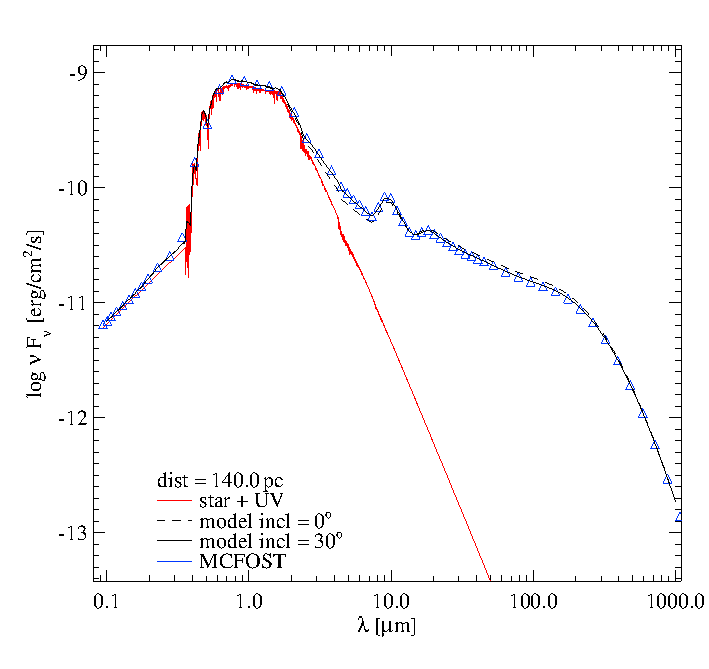
The figure shows the kind of SED accuracy we are looking for. If you can achieve that quality, you can be quite sure that the dust opacities, temperatures, mean intensities are properly passed on to ProDiMo, and that ProDiMo produced a suitable grid.
Multi-zone models
When you run a multi-zone model, make sure to specify dust/gas and fPAH in each zone, noting that the outer zone in ProDiMo is zone 1, the innermost zone in ProDiMo is zone 2 etc.
zone2 ... [zone 3 ... [zone 4 ...]] zone 1Where "[]" means you can omit. In a 2-zone-model, you should specify in Parameter.in
0.005       ! dust_to_gas  in outer zone
0.01        ! d2ust_to_gas in inner zone
0.01        ! fPAH         in outer zone
0.001       ! f2PAH        in inner zone
The re-adjustment of a suitable radial ProDiMo grid from MCFOST's exchange file forProDiMo.fits.gz should work automatically, including the determination of the number of zones NZONES, and gaps, but it is wise to study the stdout from ProDiMo carefully:
 READING FROM MCFOST:  forProDiMo.fits.gz ...

 MCFOST version 2.14.1
 MCFOST to ProDiMo version 2
 n_rad, nz, n_lambda =  120   70   70

   Mstar =   1.900000
    Teff =   6200.000
   Rstar =   3.600000
   Lstar =   17.1870152705656
     fUV =  0.0000000E+00
     pUV =   2.200000
   Mdust =  2.0001001E-04
     Rin =  0.2500000
    Rout =   30.00000
      H0 =   1.100000
      r0 =   10.00000
    epsi =  0.5000000
    beta =   1.000000
    amin =  0.1000000
    amax =   3.000000
    apow =   3.500000
  rho_gr =   3.500000
  settle =  0.0000000E+00
 asettle =   1.000000

 ... detected 1 holes and 2 zones:
 zone 2 from    0.25000002335467 AU to   28.26718910431741 AU
 zone 1 from  140.00000197610575 AU to  300.00000000000000 AU
   disk from    0.25000002335467 AU to  300.00000000000000 AU

 zone 2:  dust/gas = 1.000E-02 fPAH = 1.000E-02
 zone 1:  dust/gas = 1.000E-02 fPAH = 1.000E-02

 beta_max=   30.9426872605686

 detected Nzone =           2
 detected Ngaps =           1
 ...
 taking over lambda-grid & incident Int.
 NUV1,NUV=           3           9
 ...
 calculating column densities
           1  0.250000023354674       5.908288995499093E+021
           2  0.251530556370283       5.890286025001251E+021
           3  0.256122272190482       5.837247221078691E+021
           4  0.286339433536542       5.509062128063851E+021
           5  0.301110609204870       5.383549741286824E+021
           6  0.334781252912953       5.096120290735470E+021
           7  0.366987008073658       4.858816950382459E+021
           8  0.384902504346483       4.761638167286310E+021
           9  0.435174136721880       4.478166331312444E+021
          10  0.492011683824119       4.211570268093337E+021
          11  0.556272711524112       3.960845298886777E+021
          12  0.628926791293445       3.725046596281422E+021
          13  0.711070129115120       3.503285578347285E+021
          14  0.803942105057949       3.294726523238409E+021
          15  0.908943973063969       3.098583443040433E+021
          16   1.14004427285060       2.761037101408729E+021
          17   1.31363325208360       2.577476374780669E+021
          18   1.48520524026011       2.424032960794197E+021
          19   1.67918603019324       2.279724429288384E+021
          20   2.14646342083968       2.016368999370176E+021
          21   2.42681031071742       1.896329665410184E+021
          22   3.08705753519752       1.680318860612417E+021
          23   3.50729947623887       1.577412685935551E+021
          24   4.45804311171118       1.398143427450189E+021
          25   5.06885501586194       1.312129867894473E+021
          26   6.47939637506116       1.160551678880762E+021
          27   7.32566219277675       1.091461226944690E+021
          28   9.36421912014953       9.653748279905089E+020
          29   11.9700577808020       8.538540334777842E+020
          30   13.5334519844599       8.030220369311671E+020
          31   17.2994886331865       7.102563455621818E+020
          32   22.1135233873364       6.282070182259526E+020
          33   28.2671891043174       5.556360907750159E+020
          34   28.5498609953606        25604635691649.7
          35   36.3094386203707        32563729406387.8
          36   46.1779948119784        41414237859992.9
          37   58.7287296603579        52670229386798.2
          38   74.6906335271345        66985491150081.9
          39   94.9908293427696        85191503375954.2
          40   120.808423133123        108345734618776.
          41   133.920397965329        120105068187205.
          42   138.600001956345        124301920682935.
          43   140.000001976106       2.887202287376513E+023
          44   140.129504749818       2.884533409562567E+023
          45   140.518022951484       2.876555751826006E+023
          46   142.072095758149       2.845083468930210E+023
          47   144.171453014339       2.803648161775390E+023
          48   147.016568287865       2.749384571347583E+023
          49   152.737489711649       2.646340929800989E+023
          50   155.893245257319       2.592825318925674E+023
          51   158.969681291275       2.542658969101490E+023
          52   165.305884907291       2.445202110423491E+023
          53   168.568072310692       2.397884030098453E+023
          54   171.894636530810       2.351487013651214E+023
          55   178.587746278871       2.263335794889140E+023
          56   182.273420221898       2.217612375856819E+023
          57   185.870449182822       2.174693098458693E+023
          58   192.594573399793       2.098599447401853E+023
          59   197.093075005053       2.050848155181887E+023
          60   200.982558715447       2.011153616892906E+023
          61   204.948798463733       1.972229746473382E+023
          62   212.450945976816       1.902462264592444E+023
          63   217.323351212632       1.859919634771975E+023
          64   221.612064219967       1.823925626531229E+023
          65   225.985411755329       1.788625183899020E+023
          66   233.715409165855       1.729330516426738E+023
          67   239.259237361201       1.689363168157565E+023
          68   244.359049470396       1.654163299603391E+023
          69   249.181291664232       1.622151247351913E+023
          70   254.098697183619       1.590756097798077E+023
          71   262.376974363645       1.540383579644759E+023
          72   268.397378807194       1.505881714815123E+023
          73   274.516345789186       1.472398078111046E+023
          74   280.180216424611       1.442660825499823E+023
          75   285.709362426977       1.414742452906459E+023
          76   290.126807337815       1.393105748760227E+023
          77   293.887285002163       1.375240336365060E+023
          78   296.902248084777       1.361395808031002E+023
          79   299.035739889000       1.351981547435153E+023
          80   300.000000000000       1.347838923338465E+023
 checking dust and gas masses ...
 dust_to_gas_c =  1.000000000000000E-002
 ProDiMo: Mgas/Msun =  1.999E-02 Mdust/Msun =  2.224E-04
  MCFOST: Mgas/Msun =  2.140E-02 Mdust/Msun =  2.371E-04

 end reading data from MCFOST-ProDiMo file
The lower part of the output shows the final choice of ProDiMo's radial gridpoints and associated column densities. There should be a point with large column density right at the extracted value of the outer radius of the inner zone R2out, next grid point should have very low column density situated shortly thereafter in the gap, then a point with large column density at the inner radius of the outer zone Rin and the previous point, still in the gap, should have very low column density and small distance to Rin, see multiple_zones for further details.
Peter Woitke, 24.10.2012
ProDiMo to MCFOST
This interface allows to run the MCFOST line radiative transfer on top of a ProDiMo model. Where ProDiMo provides the molecular concentrations, the gas temperature and the population levels.
TODO: How To do this? MCFOST still seems to have the option.