H2O cooling
Default setup (recommended)
By default ProDiMo uses the Lamda database files ("ProDiMoDir/data/H2O_ortho_rovib_Lamda.dat" and "ProDiMoDir/data/H2O_para_rovib_Lamda.dat") for ro-vib cooling (see https://home.strw.leidenuniv.nl/~moldata/H2O.html). We currently recommend to just use this default setting. Please cite the papers listed on the Lamda webpage if you use this setup (at least if water is relevant for your study).
There are various other options which can be used and are described in the following.
Pure rotational cooling
By setting
.false. ! H2O_rovib_Lambda ProDiMo only uses the rotational data from the Lamda database.
By setting:
.false.   ! H2O_rovib_Lambda
.true.    ! H2O_Daniel2011
The pure rotational data from Daniel+ 2011 is used instead of the Lamda pure-rot data.
For the Daniel et al. data please cite the following papers:
- Dubernet, M.-L., Daniel, F., Grosjean, A., et al. 2006, A&A 460, 323
- Dubernet, M.-L., Daniel, F., Grosjean, A., & Lin, C. Y. 2009, A&A 497, 911
- Daniel, F., Dubernet, M., Pacaud, F., & Grosjean, A. 2010, A&A 517, A13
- Daniel, F., Dubernet, M., & Grosjean, A. 2011, A&A, 536, A76
A dedicated paper on the effects in choosing different rates can be found here Daniel+ 2012
Deprecated options
Before ProDiMo Version 3.0 the recommended default (e.g. DIANA models) was:
.true.    ! H2O_rovibration
.true.    ! H2O_Daniel2011
We recommend to not use this setup any more (if possible) as it uses rather old data from Hitran 2009 which is not suitable to e.g. model JWST data.
However, for backward compatibility we still allow such a setup (e.g. the DIANA models should still run as they are), and hence we describe further details in the following.
By default ProDiMo used the ro-vib data from Lamda. By setting the switches in Parameter.in
.false.  ! H2O_rovib_Lambda : Switch off the Lamda file
.true.   ! H2O_rovibration : include water ro-vibrational levels
500      ! sparse_Nlev : minimum number of levels before using the Sparse solver
ProDiMo will take 411 ortho-water rovibrational levels and 413 para-water rovibrational levels. The levels are connected by collisions with electrons and H2 using the rates computed by Faure et al. 2008 (A&A 492,257 ) [http://adsabs.harvard.edu/abs/2008A%26A...492..257F]. The energy levels, transition frequencies, and Einstein A coefficients are taken from the HITRAN database [http://www.cfa.harvard.edu/HITRAN/] 2009 update for water. This is also the case if additionally .true. ! H2O_Daniel2011 is set.
I suggest not to use the sparse solver because the matrix is not very sparse and not very large.
The current collision rates are:
- pH2O - pH2, pH2O - oH2, oH2O - pH2, pH2O - pH2 : pure rotational transitions (Faure et al.) 20 - 2000 K
- pH2O - H2, oH2O - H2 : rovibrational transitions (Faure et al.)
- pH2O - He, oH2O - He: rotational transitions (Green et al.)
- pH2O - e, oH2O - e : rotational and rovibrational levels (Faure et al.)
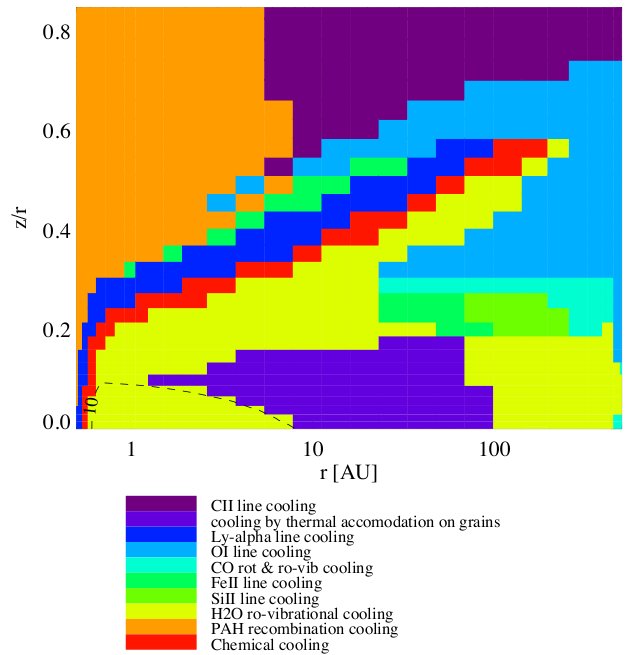
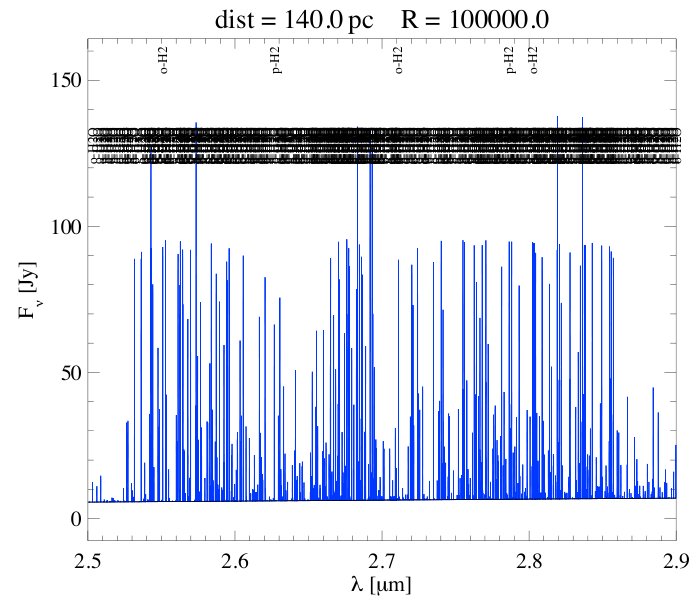
Water ro-vibrational cooling can become one of the major coolants in hot and warm molecular regions (see Figure below, HerbigAe star with , , , --, , ).
Relevant data files
The relevant files in /data/ are
data/H2O_hitran2009_01.txt
data/H2O_ortho_rovib_Faure2008.txt
data/H2O_ortho_rovib_levels_Faure2008.txt
data/H2O_para_rovib_Faure2008.txt
data/H2O_para_rovib_levels_Faure2008.txt
data/H2O_ortho_He_Green1993.txt
data/H2O_para_He_Green1993.txt
Sensitivity study
As expected, the fact to solve large matrices slows down the code.
The flag
.true. ! H2O_coll_rate_sensitivity_analysis will be used to make a line flux sensitivity study. For that, ProDiMo will vary randomly the actual collisional rates with the same order of magnitude than the actual rates. Two data files with the fake rates will be written oH2O_HITRAN_Faure_sens_analys.dat and pH2O_HITRAN_Faure_sens_analys.dat.
Taking a closer look
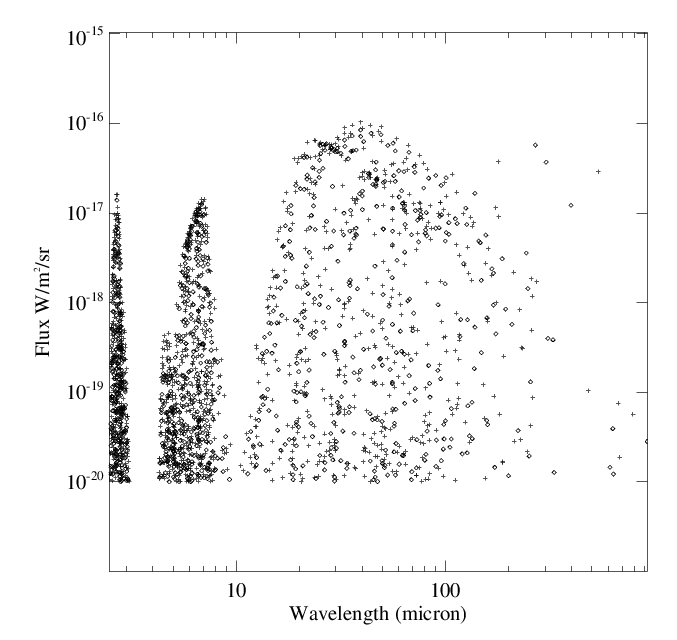
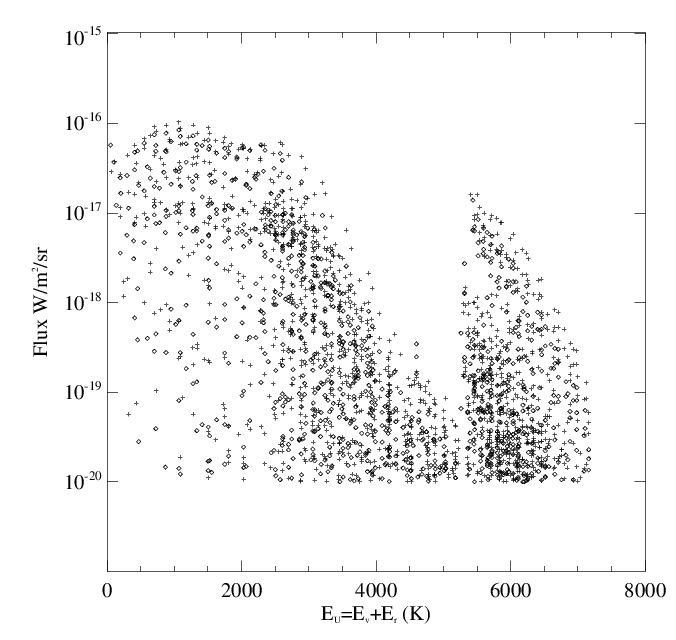
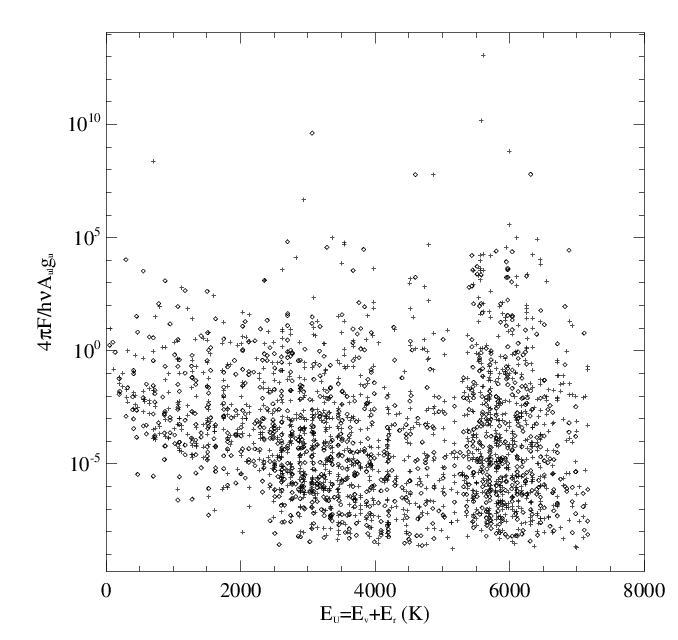
in ../idl/, there is a program to plot flux and rotational diagram for water ro-vibrational lines called rotH2O.pro . It produces a file called rotH2O.ps with a default flux cut-off at 1e-20. You can change the code to have more lines by lowering the cut-off level.
Population level convergence
Keto argues that the water level population convergence is not attained for radiative-transfer codes based on the lambda-iteration scheme. At high optical depth (from the line itself like water) the change in tau only results in a small change in Jbar, which is used to update the population (exp(-tau)), while in an escape-probability based solver like ProDiMo, the change in the escape beta is 1/tau for high values of tau, therefore the population changes most rapidly.