N.B. Only available for the master version. (23/7/2024 Wing-Fai Thi)
Introduction
The 13CO/12CO ratios in protoplanetary disks are found to be high and are used together with other CO isotopologues as tracers of the disk gas mass (H2).
The standard ProDiMo chemistry does not include 13C fractionation reactions. The 13CO/12CO ratio is a user-provided value set by the flag C13_C12 with a default value of 0.014 (Henkel et al. 1994). In short, ProDiMo assumes that the isotopologue ration is equal to the elemental abundance. The 13CO abundance is a constant fraction of the 12CO abundance throughout the entire disk.
Simple local estimate of the 13CO/12CO ratio
For a basic introduction to carbon isotopic fractionation in the disk framework we refer the reader to Woods & Willacy (2009) and to the review by Nomura et al. (2023).
One can estimate the chemical fractionation of 13CO due to the reaction 13C+ + 12CO -> 13CO + 12C+ + dE, with dE = 35K being the excess energy of the fraction reaction in Kelvin, and its reverse reaction. Other important reactions include the differential self-shielding against photodissociation. However, the main C exchange reaction has been found to be the most important contributor to the final ratio (Bergin et al. 2024, Tomohiro et al. 2022, Lee et al. 2024, Miotello et al. 2014, Langer et al. 1984).
Estimated 13CO/12CO ratio in ProDiMo models
Setting the flag
.true. ! estimate_13CO_12CO_ratio will result in an estimate of the local 13CO/12CO ratio based on the C-exchange reaction only. The flag is independent from the chosen chemical network. ProDiMo calculates the abundances of carbon-bearing species and from the local conditions and these abundances, it estimates the ratio due to the fractionation.
Example
The 13CO/12CO varies throughout the disk. A low value compared to the elemental value means that the chemical fractionation is efficient. The fractionation affects mostly the outer disk where the gas temperature is low enough such that the reverse reaction (with a exp(-dE/T) term in the rate) is slower.
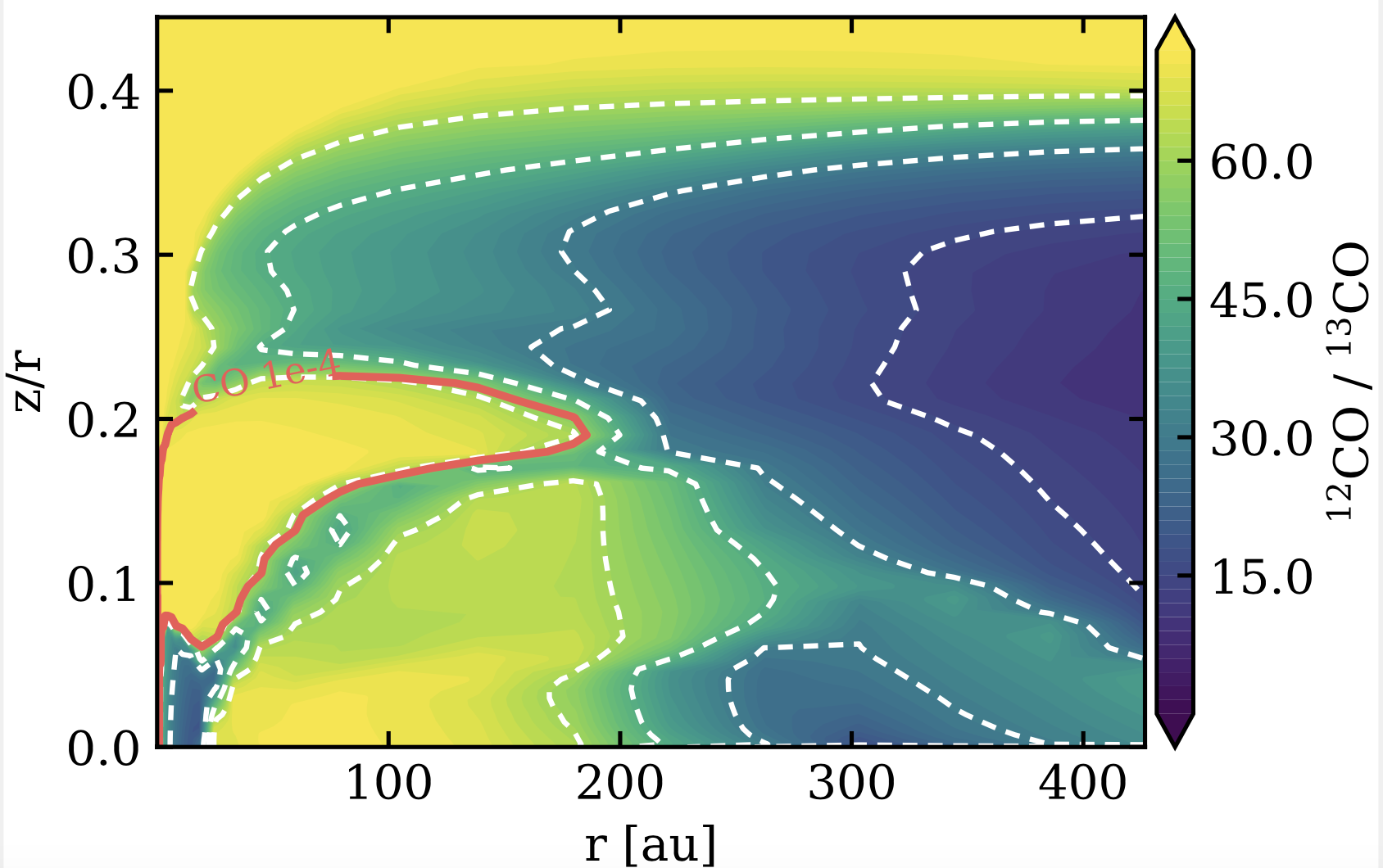 The effects will be seen in the line data cubes.
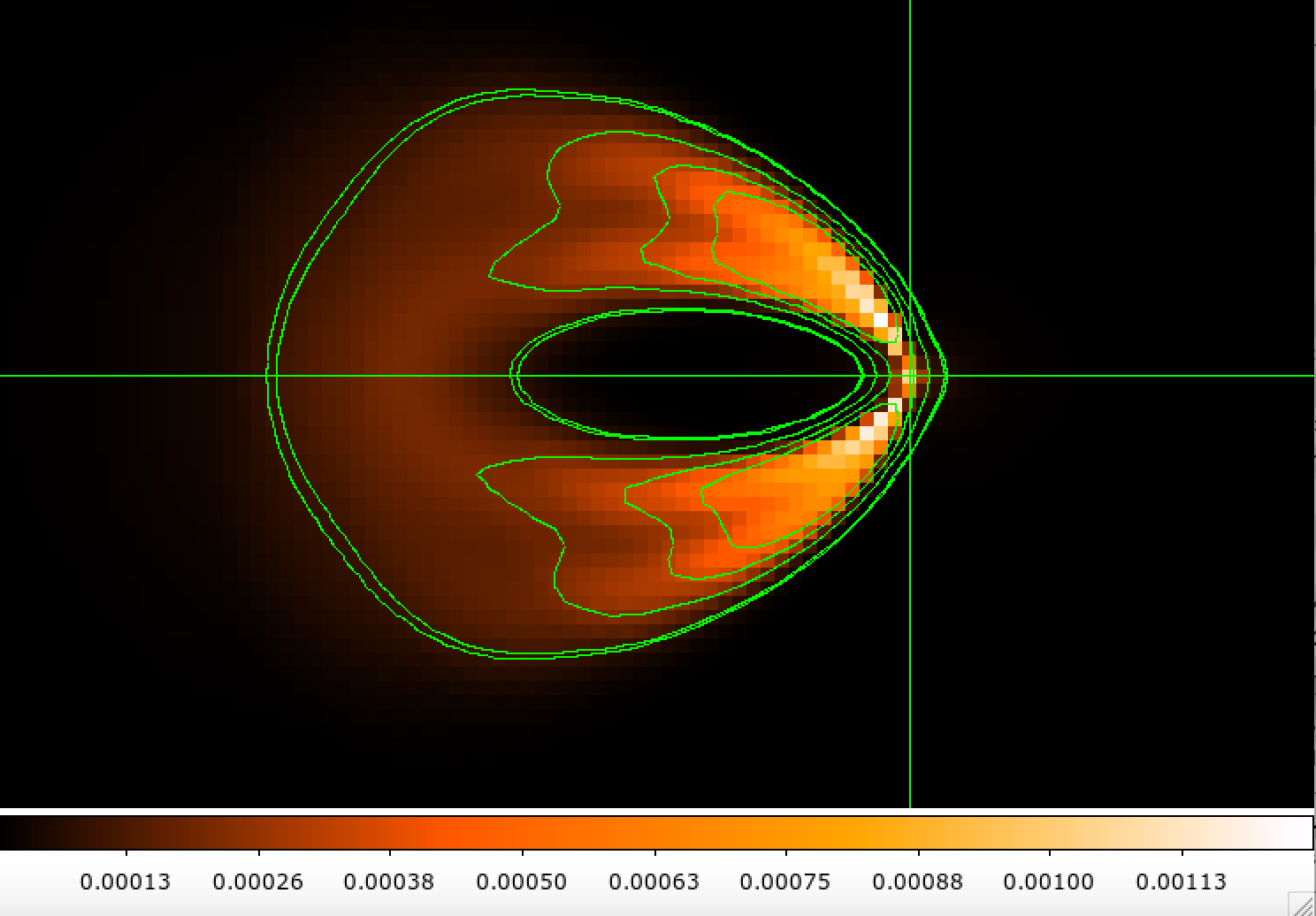
The first image is a model with constant 13CO/12CO. 13CO 2-1 channel map with the same contour levels in both images. 45 degree inclination.
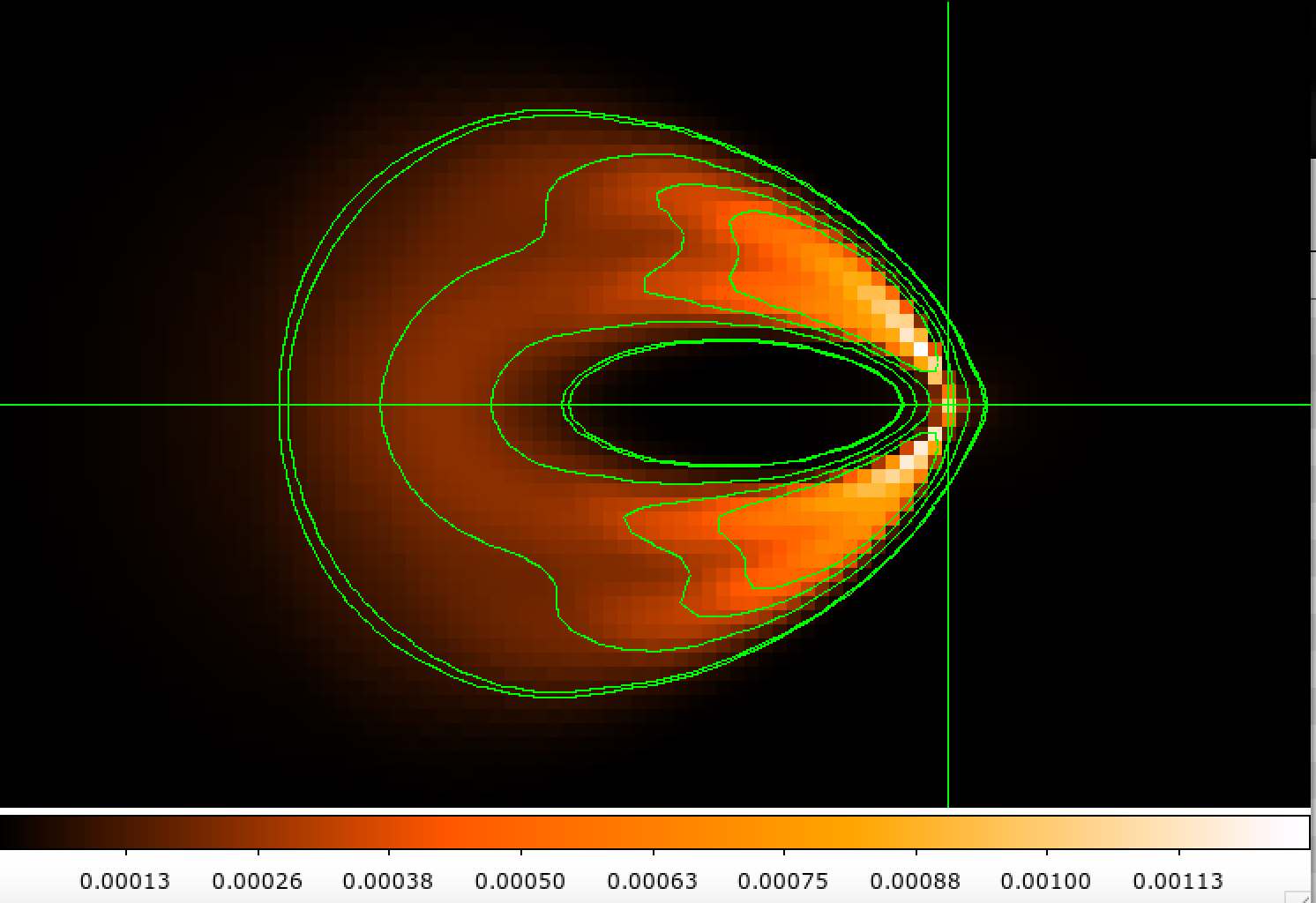
The second image is the same model with the estimated 13CO/12CO. The 13CO emission is stronger in the outer disk compared to the constant 13CO/12CO model. This stems from the higher abundance.
Reference
- Bergin et al. 2024 https://arxiv.org/abs/2403.09739
- Henkel et al. 1994 The Structure and Content of Molecular Clouds, Proceedings of a Conference Held at Schloss Ringberg, Tegernsee, Germany, 14-16 April 1993. Lecture Notes in Physics, Vol. 439, edited by T. L. Wilson and K. J. Johnston. Springer-Verlag, Berlin Heidelberg New York, 1994., p.72-88
- Langer et al. 1984 ApJ, 277, 581
- Lee et al. 2024 https://arxiv.org/pdf/2404.01635.pdf
- Nomura et al. 2023, Protostars and Planets VII
- Rollig & Ossenkopf 2013 A&A 550, A56
- Tomohiro et al. 2022 ApJ, 932, 126
- Woods, P. M., & Willacy, K. 2009, ApJ, 693, 1360