Since October 2022, we can use a new method for the escape and pumping probabilities in ProDiMo, Pesc and Ppump, that depend not only on line optical depths, but also on continuum optical depths, and take into account pumping from and escape into all directions. The escape probability method is used in ProDiMo to calculate the non-LTE populations and line heating/cooling rates.
The details are explained in escpro.pdf, see Chapter 1. In a nutshell, the new method accounts for radiative pumping from and line photon escape into all directions. We assume that (i) all line and continuum radiative transfer properties are independent of location and direction and (ii) consider three major directions: radial (the rays coming from the stellar surface), vertically upwards and vertically downwards, where the latter two directions are treated as if the disk was plane-parallel.
The new method will result in slightly slower (about 20%) but physically more accurate models. To use the new probability method, just say
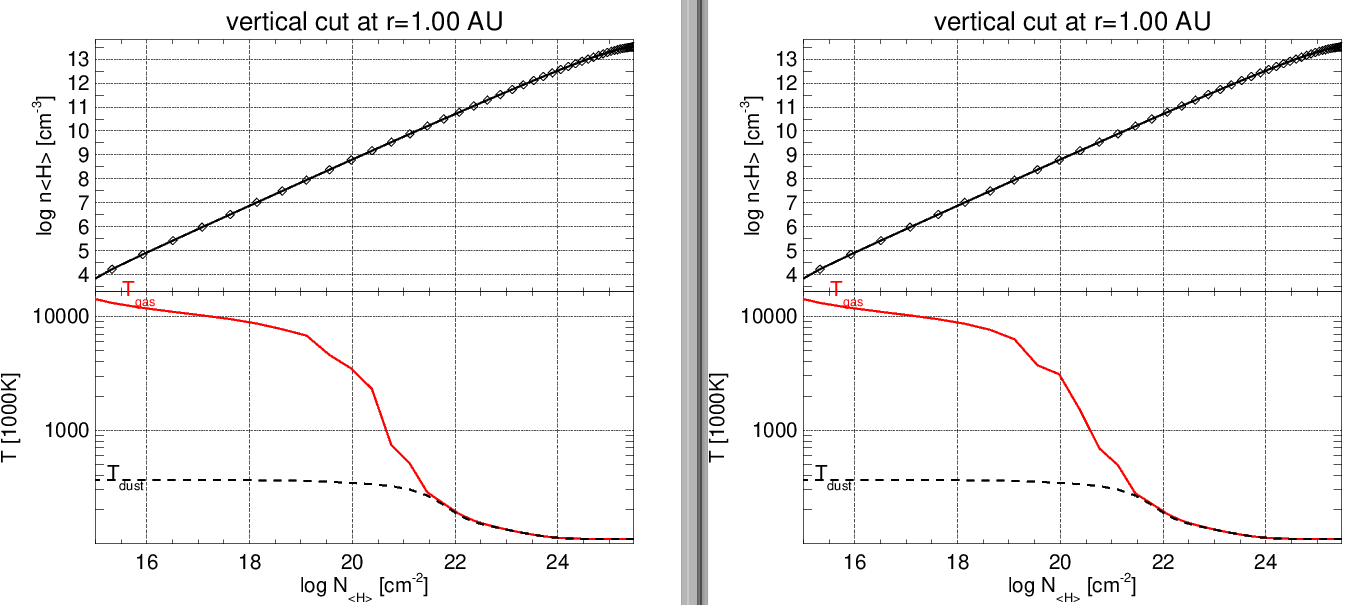
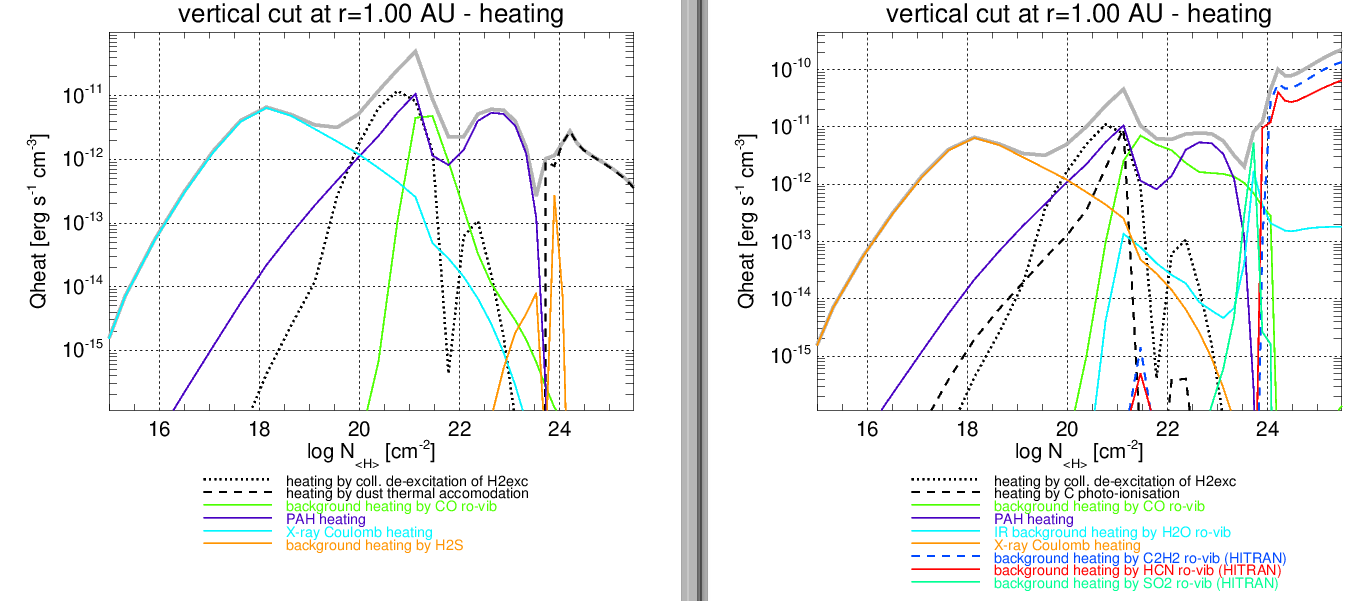
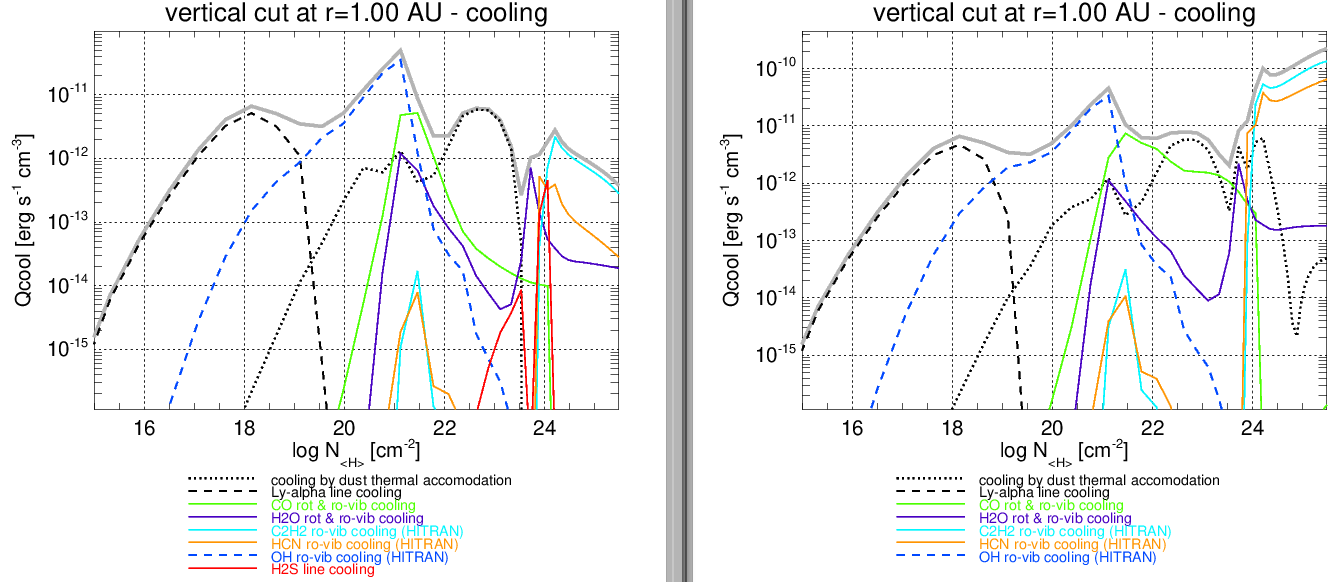
.true. ! new_escape : switch on new escape probability methodThe results shown below compare two vertical cuts at 1AU distance through our standard TTauri model. The left column of plots shows the old new_escape=F model, and the right plots show the new_escape=T model. Although the heating and cooling rates change very substantially, the resulting gas temperatures are very similar. In the old scheme, once the line optical depths are large, both Ppump and Pesc go to zero, so no IR pumping and no escape, i.e. no line heating and no line cooling. According to the new scheme, once the continuum optical depths are large, all photons will be locally re-absorbed, either by line or continuum, and it is the ratio between line and continuum opacity that will determine whether a line photon is absorbed by continuum (-> escape!) and continuum photons are absorbed in the line (-> pumping). Hence, we have a lot of line heating and line cooling in continuum optically thick regions.
The fact that the molecular heating and cooling rates dominate in the midplane means that exchanging energy between dust and gas by photons is more efficient than by inelastic collisions (thermal accomodation). Since Jv=Bv(Tdust) in the midplane, an equilibrium between line heating and cooling rates is only possible when Tgas=Tdust.
Another related new option is
.true. ! new_escape_lineflux : new line flux estimates from escape probability methodto improve the line flux estimations that are generated by ProDiMo for each line from vertical line photon escape probability. That new method, see escpro.pdf, Chapter 2, includes an approximate treatment of the continuum transfer, and takes into account that continuum photons can be absorbed by the line, an effect that systematically reduces the measured line flux. In cases where the line source function is small compared to the continuum source function, negative line fluxes are likely to occur. However, the results sometimes show lines going into absorption too soon. The new_escape_lineflux switch has an effect on the line origin analysis.
Peter Woitke, December 2022