Position dependent opacities
Revision d70db247 onwards, position dependent ice opacities can be used in ProDiMo. This enables dust opacities at any grid point to depend on local disk conditions or on user definition.
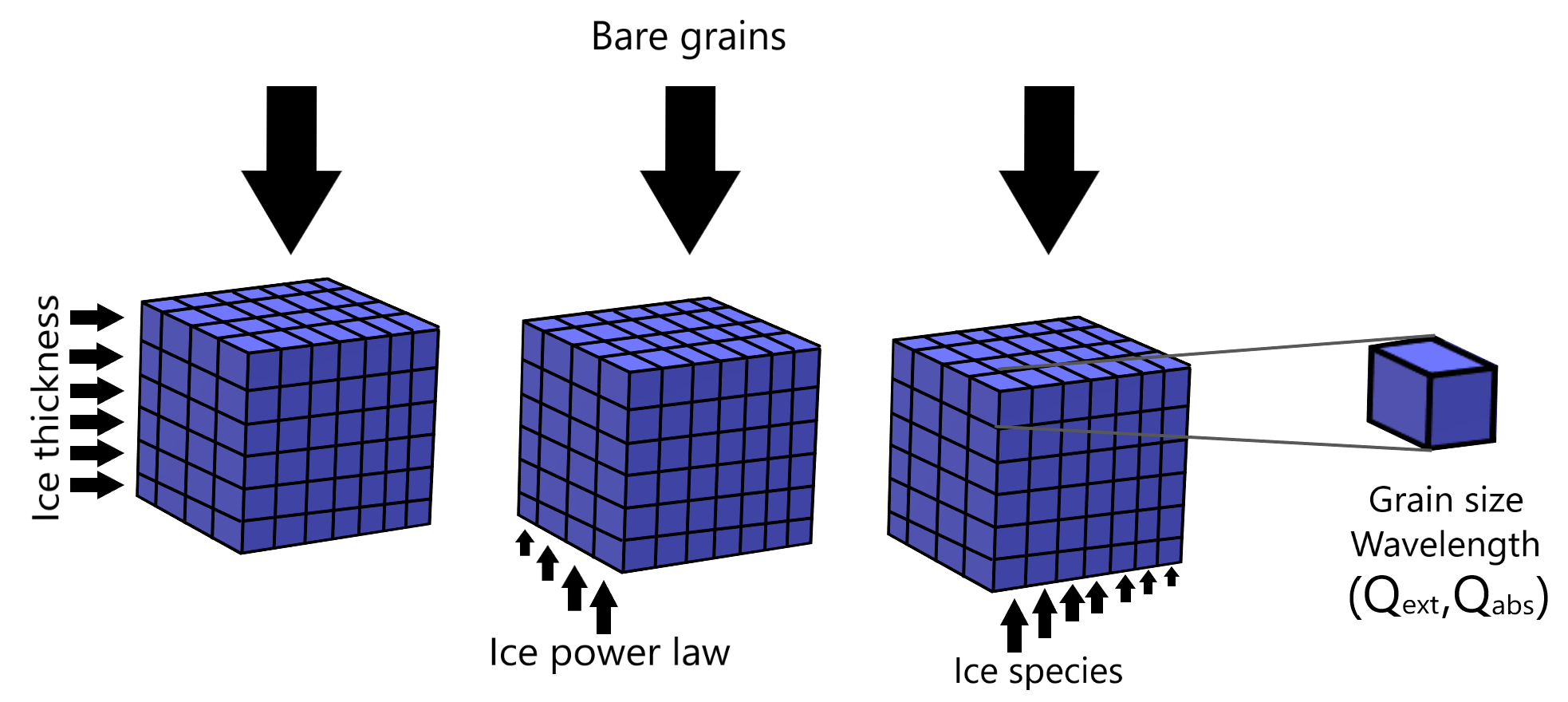
The position dependent opacities are implemented by help of a Q-Matrix (see figure below). This matrix is a multi-dimensional matrix whose dimensions are bare grain composition, ice species, ice volume, ice power law, grain size and wavelength. Ice power law, n, is defined by , where, a is the icy grain size, is the core or bare grain size, t is a coefficient determined by local ice and dust abundances and ice power law n. Here, n=0 relates to a ice thickness independent of grain size, i.e., all dust grains at a grid point have the same ice thickness (). relates to a ice thickness proportional to grain size, i.e., smaller grains have smaller ice thickness and larger grains have larger ice thickness (). Values can be representative of regions where grains stick or shatter.
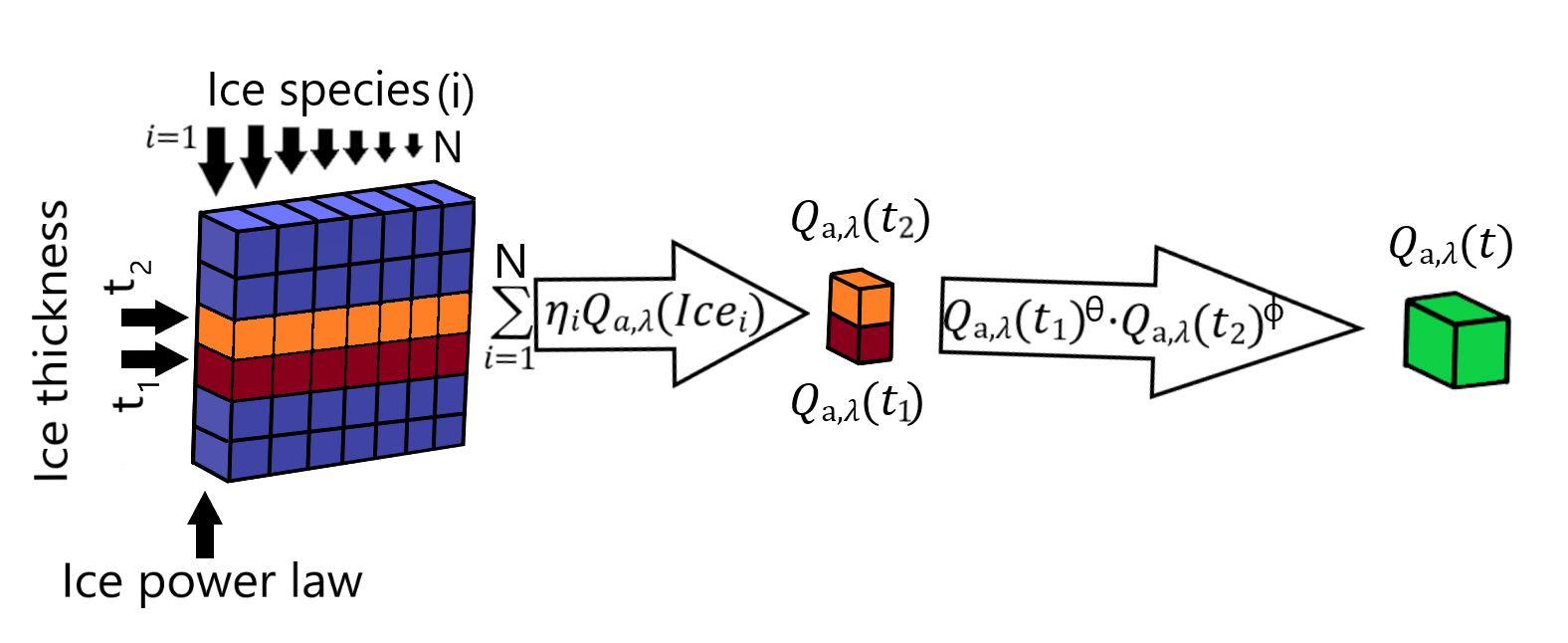
This Q-matrix is precalculated and using the values from this matrix the corresponding values for each grid point is interpolated (see figure below). Ice volume dimension is the number of grid points in ice thickness dimension to be precalculated (7-8 is fine). More details about the implementation can be found here.
There are multiple ways of using position-dependent opacities:
1) Ice opacities: Opacities can be calculated from local ice abundances. 6 ice species can be included: H2O, NH3, CO, CO2, CH4 and CH3OH. The opacities for (dust+pure ice)s will be calculated and stored in a matrix from which the local opacity is interpolated. This is based on local volume abundance of those particular chemical species and dust grains at the grid point. Ices accreting on dust grains have effects on size distribution and on extinction, absorption and scattering efficiencies. We refer to Arabhavi et al. 2022 or thesis link for detailed description of the effects on including ice opacities. We also require that the Arabhavi et al. 2022 paper to be cited if an article uses the position-dependent opacities.
The default dust setup for bare grain opacity in ProDiMo (Parameter.in):
3           ! NDUST               : number of selected dust species
  0.60      Mg0.7Fe0.3SiO3[s]
  0.15      amC-Zubko[s]
  0.25      vacuum[s]
The following shows the setup for ice opacities:
10          ! NDUST               : number of selected dust species
  0.60      Mg0.7Fe0.3SiO3[s]
  0.15      amC-Zubko[s]
  0.25      vacuum[s]
  1.00      H2Oice_Warren[s]
  1.00      CO2ice[s]
  1.00      NH3ice[s]
  1.00      CH4ice_Hudgins[s]
  1.00      CH3OHice_am[s]
  1.00      COice_near_far_IR[s]
  0.20      vacuum[s]
7           ! NMANTLE           : number of ice species in dust
.true.      ! QPosDep           : position dependent opacities
8           ! QIndexTotVol        : number of points in volume dimension of Q matrix
Here ! NDUST should include number of bare grain materials and ice species. Followed by volume fraction of the species and the species ID. However, the volume fraction is only relevant for bare grains and can be any value for ice species since that is determined locally for each grid point. ! NMANTLE specifies the number of ice species from the bottom of the list. Note that the above example lists vacuum[s] twice. This is to account for porosity in both ice mantle and bare grain core and the volume fraction mentioned is retained while calculating the opacities. ! QPosDep is a switch used to tell ProDiMo to use position dependent opacities. ! QIndexTotVol is the volume dimension of Q-matrix. In the above example, a total of 10 species is used for opacity calculation, with first NDUST-NMANTLE (10-7=3) species in the bare grains/core and rest NMANTLE (7) species in the ice mantle. Ice power law value can be specified using 0.5 ! icepot, however, the default value is 0. One can also define different values of ice power laws for different regions of the disk using ! NIPL, as shown below:
2       ! NIPL        : number of ice powerlaws [icepot r1 r2 z/r1 z/r2]
 0.00   0.00    1000    0.10    1.00
 1.00   0.00    1000    0.00    0.10
The lines following ! NIPL reads ice power law, co-ordinates of diagonal of a region within which that power law applies. Regions not covered by this definition will use the value of the first ice power law (0.00 in this case).
2) Dust opacities: Similar to defining different ice power laws for different user defined regions, one can also define particular type of bare grain for different regions of the disk using ! NBaregrains input parameter (see Q Matrix figure above). This is shown below:
3          ! NDUST               : number of selected dust species
  0.60      Mg0.7Fe0.3SiO3[s]
  0.15      amC-Zubko[s]
  0.25      vacuum[s]
.true.      ! QPosDep         : position dependent opacities
3           ! NBaregrains         : number of bare grains
            ! BareComp            : composition of the NBaregrains
 0.60  0.15  0.25
 0.15  0.60  0.25
 0.40  0.35  0.25
            ! BarePos             : position of the NBaregrains [r1,r2,z/r1,z/r2]
 0.00   100 0.00    1.00
 100    1000    0.00    0.20
 100    1000    0.20    1.00
In the above example, three regions are identified by ! BarePos having different bare grain compositions defined by ! BareComp.
3) Ice+Dust opacities: The above setups can be combined to define different bare grain opacities and including ices and ice power laws as shown below:
10          ! NDUST               : number of selected dust species
  0.60      Mg0.7Fe0.3SiO3[s]
  0.15      amC-Zubko[s]
  0.25      vacuum[s]
  1.00      H2Oice_Warren[s]
  1.00      CO2ice[s]
  1.00      NH3ice[s]
  1.00      CH4ice_Hudgins[s]
  1.00      CH3OHice_am[s]
  1.00      COice_near_far_IR[s]
  0.20      vacuum[s]
7           ! NMANTLE         : number of ice species in dust
.true.      ! QPosDep         : position dependent opacities
8       ! QIndexTotVol        : number of points in volume dimension of Q matrix
3           ! NBaregrains         : number of bare grains
            ! BareComp            : composition of the NBaregrains
 0.60  0.15  0.25
 0.15  0.60  0.25
 0.40  0.35  0.25
            ! BarePos             : position of the NBaregrains [r1,r2,z/r1,z/r2]
 0.00   100 0.00    1.00
 100    1000    0.00    0.20
 100    1000    0.20    1.00
2       ! NIPL        : number of ice powerlaws [icepot r1 r2 z/r1 z/r2]
 0.00   0.00    1000    0.10    1.00
 1.00   0.00    1000    0.00    0.10
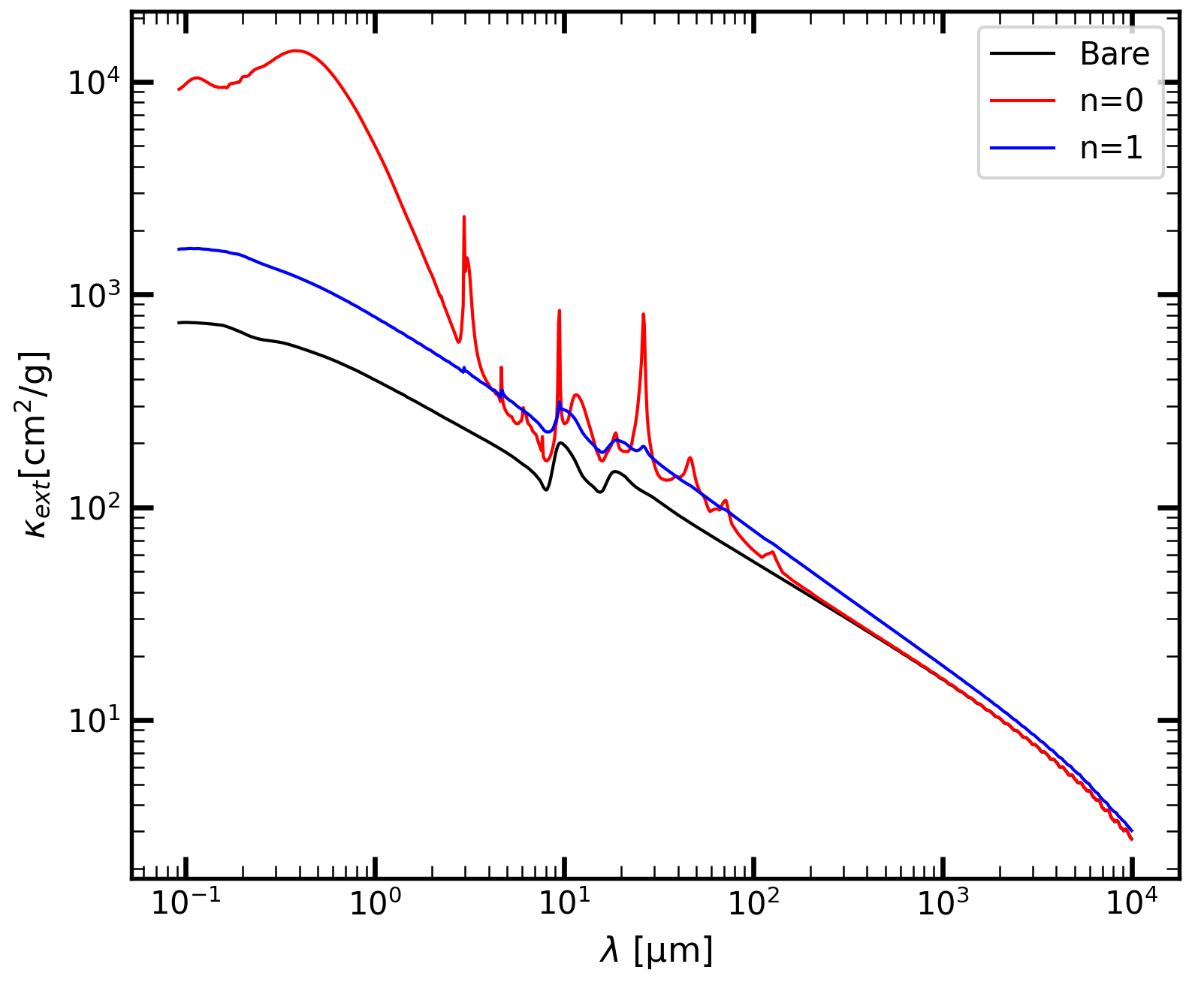
Following figure shows the effect of ice opacities and ice power law. Here, the disk mass average opacity of the disk is plotted against the opacity. "n" refers to ice power law, with "n=0" being constant ice thickness and "n=1" being grain size dependent ice thickness. The figure shows that the opacities are higher for "n=0" and it strongly depends on the ice power law.
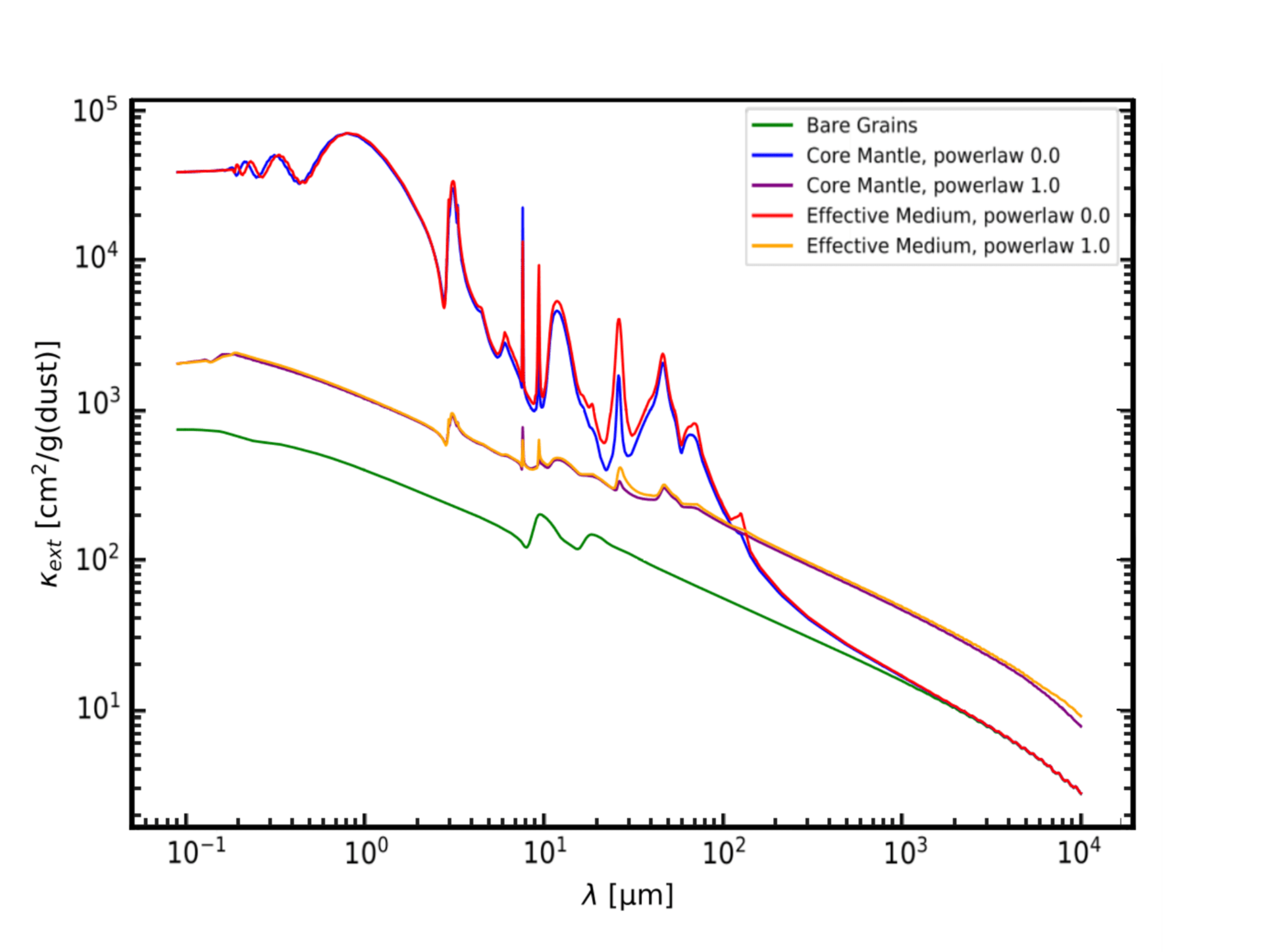
Note: One can also use Core-Mantle Mie calculations instead of a completely mixed grain, i.e., in this way Mie efficiencies take into account the refractory core and icy mantle. This option can be used by using the switch .true. ! CoreMantle. However, one should also note that these calculations are about four times longer than effective medium Mie calculations. The difference between the effective medium and core-mantle options are small, see the below figure.