Escape probability calculation with a Voigt profile
For allowed transitions (transitions in the optical and UV), the nature width (equal to the sum of the Einstein coefficients from the upper level) becomes not neglected compared to the Doppler (turbulent + thermal) width. The line profile is the convolution of a gaussian (Doppler) and a Lorentzian (Natural), which is called a Voigt profile (see radiative transfer textbooks). At small distances from the line center, the Voigt profile behaves likes a gaussian profile and at large distances like a Lorentzian profile. By default, the gaussian profile escape probability is used. If
----- OI, CI, CII with optical and UV transitons -----
.true.   ! UVpumping
or/and
----- H2 formation -----
.true. ! UV_H2
or/and
----- CO rovibration - fluorescence -----
.true.     ! custom_COrovib
60         ! COX_Nrot
2           ! COX_Nvib
2           ! COA_Nvib
then you should use the escape probability with a Voigt profile:
------ voigt profile -----
.true.     ! Voigt_escape
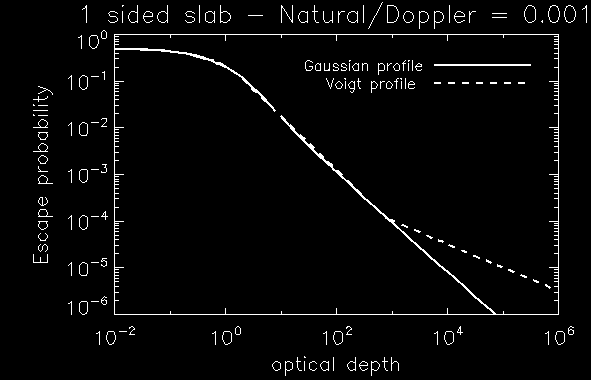
The figure below shows the escape probability as function of optical depth (maximum 0.5 for a semi-infinite slab). For a gaussian profile the probability is 1/tau at tau and for a Voigt profile the escape varies as 1/sqrt(tau) (escape by the Lorentzian wings).
We adapted the analytical formulation of Apruzese (1985) to match the formulation in Woitke et al. (2009) at low optical depths and small intrinsic line widths. At high optical depth, the escape probability β varies as 1/sqrt(τ) (Voigt profile) instead of 1/τ (Gaussian profile):
β = 0.5/(1 + 1.5τ) if τ ≤ 1
β = 0.25τ^(−1.15) if 1 < τ < τc
β = 0.25τ^(−0.5) τc^(−0.65) if τ > τc,
where a is defined as Γ/(4π∆νD) and τc is the critical optical depth and is defined as 0.83/(a(1 + a)). Γ is the sum of the natural and collisional width while ∆νD is the effective Doppler width (Rybicki & Lightman 1986). In addition to the UV line shielding, dust grains contribute strongly to the UV flux attenuation. The main limitation in using the escape probability technique is it does not take overlapping line effects into account.
References:
Apruze J. P. An analytic Voigt profile escape probability approximation J. quant. Spectrosc. TRadiat. Transfer Vol. 34, No 5, pp. 447-452