Dust settling
ProDiMo allows for various ways to include the effects of dust settling. By default, no settling is activated, so one has to choose.
"MCFOST" settling
The first method (settle_method=1, default) is adopted from MCFOST, assuming that the scale heights of larger dust particles are decreased with a power law in size
1           ! settle_method     : like in MCFOST
0.3         ! dust_settle       : dust settling exponent
0.05        ! a_settle [mic]    : minimum dust size to be affected by settling
The default choice is dust_settle=0.0, which means un-settled (well mixed), where dust/gas, dust opacities/mass, dust moments etc. are all constant throughout the disc.
If dust_settle>0.0 the vertical profile will deviate from the gas profile . We calculate that profile for every particle size with modified
which is analogous (because ) to assuming reduced scale heights for larger dust particles. We then calculate the vertical stratification of those dust particles, just as we do for the gas. is the square of the isothermal gas sound velocity.
and refer to the gas, and and refer to dust particles f(a)da, i.e. we utilize the calculated vertical gas distribution and scale it in a certain way. We are aware that this approach is quite un-physical. In the end, the resulting f(a,z) is normalized such that (for each size) the vertical column density is the same as in the unsettled case.
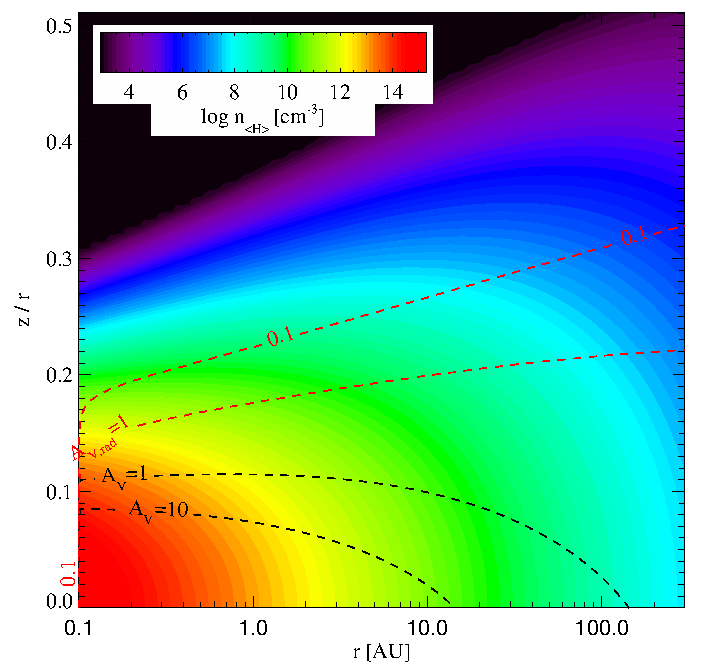
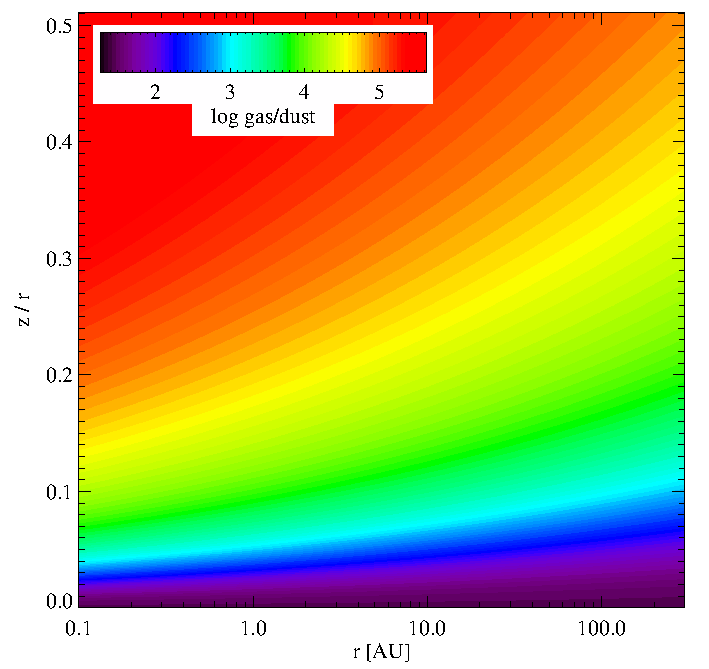
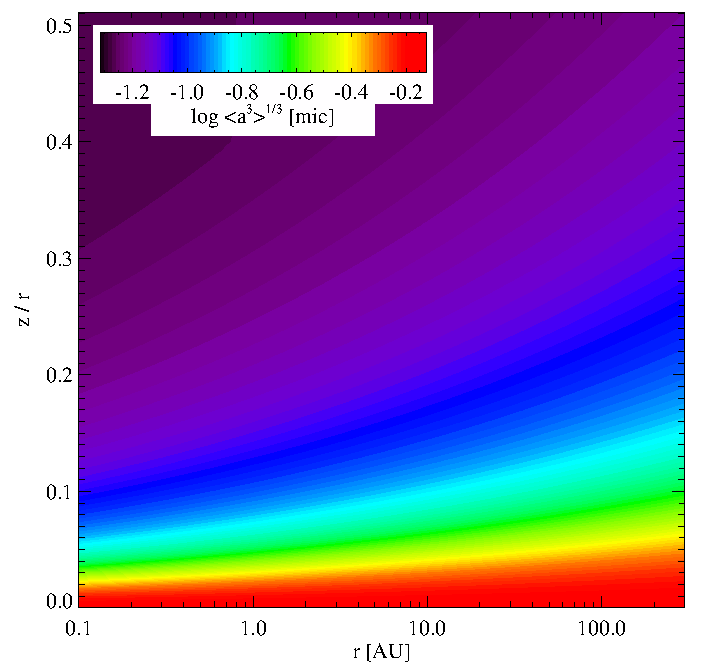
The figures show the density structure, the local dust/gas ratio, and local dust mean particle size for a TTauri model with prescribed density structure.
Dubrulle settling
Alternatively, the more physically justified dust settling description of Dubrulle et al. (1995) can be used, solving for the equilibrium between sedimentation due to gravity and diffusion due to turbulence, for all particle sizes.
2           ! settle_method     : dust settling (Dubrulle et al. 1995)
0.01        ! a_settle          : turbulence alpha
with . According to this description, dust settling mainly happens in the outer region, because the settling is density-dependent. Note that this method uses the midplane dust temperature Tdust(x,z=0), which is not known a priori, so the models with settle_method=2 need to be iterated, even if the gas density is prescribed in a parametric way.
TODO: Check this last statement, Dubrulle settling does not need a global iteration.
Consequently, the dust vertical extension effectively becomes flatter with increasing distance according to the Dubrulle settling, so it has a similar effect (on the dust) as decreasing MCFOST_BETA. However, the gas stays strongly flared.
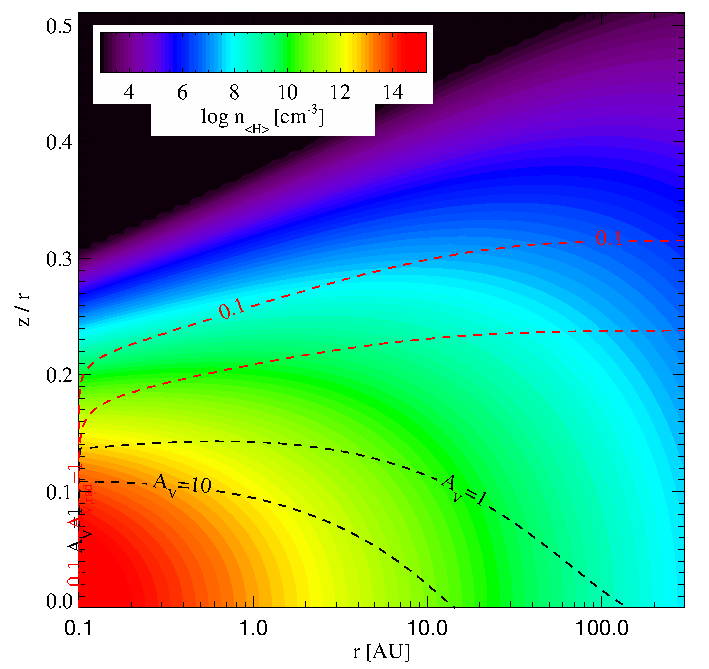
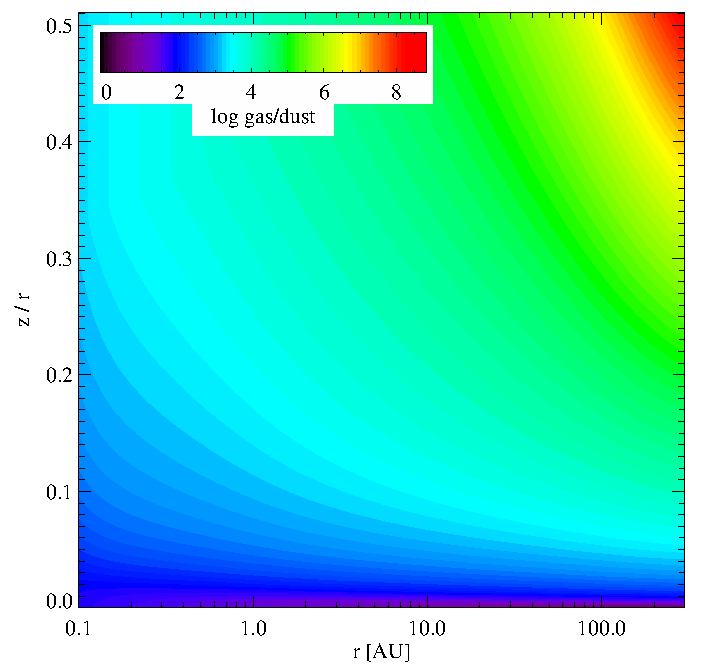
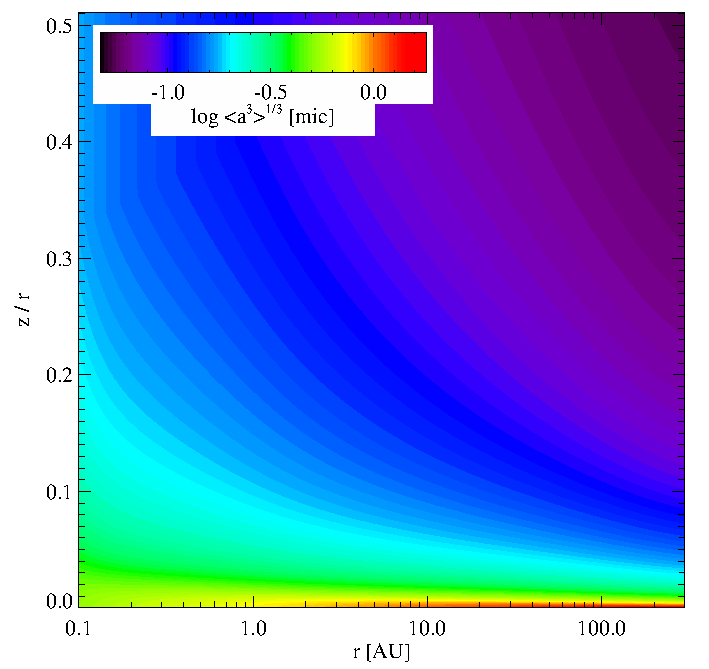
If dust settling is included (in either way), the dust opacities need to be re-integrated over size space at every point in the disk after each call of disk_structure. Hence, the dust opacities per dust mass, the dust moments as well as the dust/gas ratio are all spatially dependent quantities. This has interesting consequences for the dust temperatures in the disk.
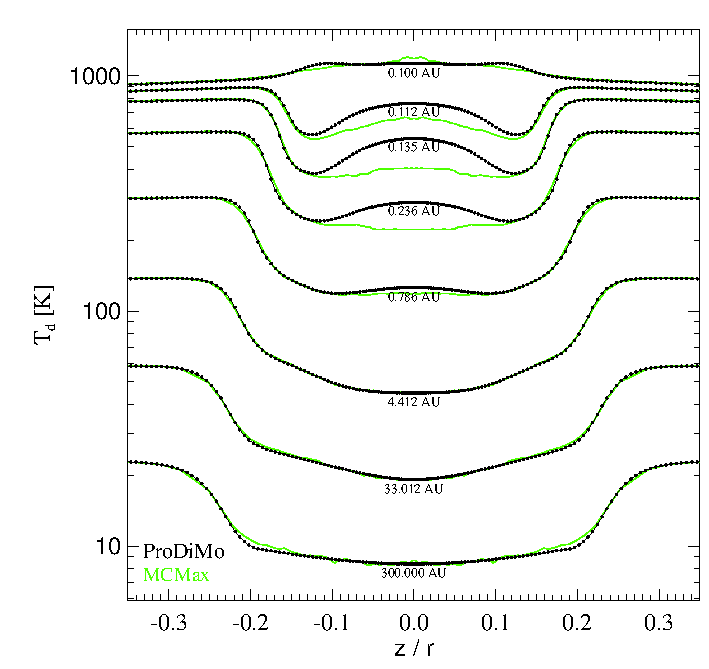
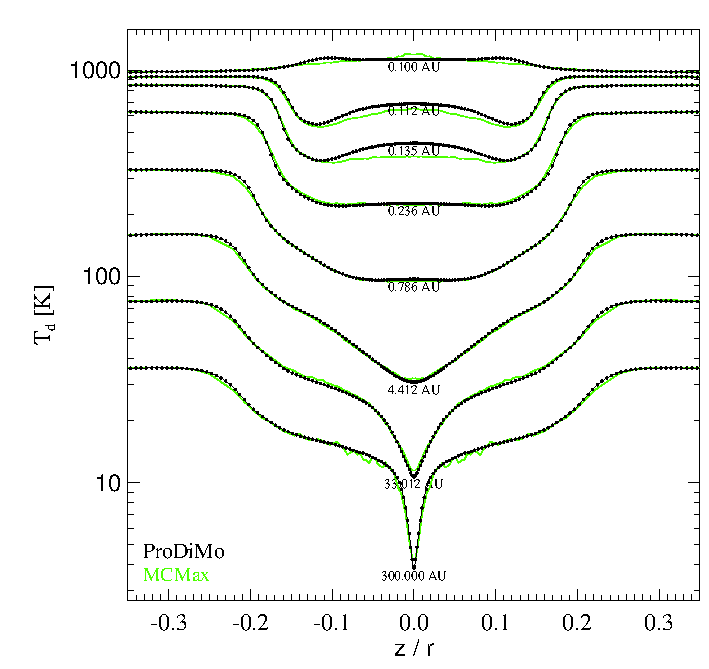
The L.H.S. diagram shows the calculated Tdust(r,z) without dust settling, the r.h.s. with Dubrulle-settling, in comparison to the same model setups calculated with MCMax. In the distant midplane, practically all larger particles gather in the midplane, which makes it cooler in comparison to the layers above, where the dust particles are remarkably smaller on average. This produces a strong vertical Tdust-gradient. This has nothing to do with shadow formation. It's just the effect of changing opacity in a given radiation field.
Riols & Lesur settling
3           ! settle_method     : dust settling (Riols & Lesur (2018))
1.E-3       ! a_settle          : settling parameter (turbulence_alpha)
Riols & Lesur (2018), Eq. (33). This last method has been used in Woitke et al. 2024, where you will also find a detailed description of the implementation (Section 2.9)
"DALI" settling
To use the method applied in the DALI code (for details see Bruderer+ (2013)).
-1 ! settle_method : dust settling (DALI)Also, dust_settle for the scale height reduction, and a_settle for the mass fraction of unsettled small grains have to be set.