Mid-IR molecular lines
In addition to CO and H2O, for which special treatments are available, other emission lines in the mir-IR can be modelled using ProDiMo. The transitions are taken from the HITRAN database. We request that papers using data from this database cite the relevant papers. The parameters to generate mir-IR lines are:
.true.      ! C2H2_LTE_cooling
.true.      ! CH4_LTE_cooling
.true.      ! CO2_LTE_cooling
.true.      ! NH3rovib_LTE_cooling
.true.      ! HCNrovib_LTE_cooling
.true.      ! H2COrovib_LTE_cooling
.true.      ! CH3OHrovib_LTE_cooling
.true.      ! NOrovib_LTE_cooling
.true.      ! O2rovib_LTE_cooling
.true.      ! SO2rovib_LTE_cooling
.true.      ! CSrovib_LTE_cooling
.true.      ! CH3CNrovib_LTE_cooling
.true.      ! OHrovib_LTE_cooling
.true.      ! H2Srovib_LTE_cooling
.true.      ! CH3_LTE_cooling
.true.      ! C2H4_LTE_cooling
.true.      ! C2H6_LTE_cooling
.true.      ! C3H4_LTE_cooling
.true.      ! C4H2_LTE_cooling
.true.      ! C6H6_LTE_cooling
The level populations are computed using a pseudo-nlte method: the rotational levels are at LTE whereas the vibrational levels are computed in a non-lte fashion when collision rates are available. When not a pseudo rate is applied. CO2, NH3, C2H2 and HCN do have vibrational collisional rates.
There is a flag to manually select only lines (transitions) that are strong at 300 K in the mid-IR
1e-20 ! hitran_min_strengthThe output on the screen/log file would display the number of lines selected compared to the total of lines selected with a upper energy of 5000 K.
By default the Hitran 2020 release of the database is activated.
.true. ! hitran2020 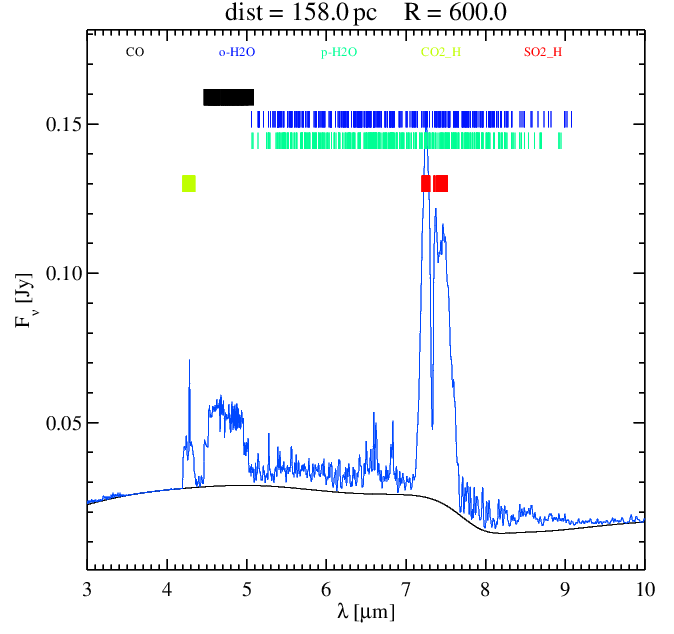 \
CO2, CO, Water, and SO2 mir-IR line emissions from a massive disk around a Herbig Ae star (R=600).
\
CO2, CO, Water, and SO2 mir-IR line emissions from a massive disk around a Herbig Ae star (R=600).
User defined HITRAN line selection
It is also possible to provide detailed line selection rules for HITRAN molecules by including a LineSelection.in file. The selection possibilities are:
- molecule selection
- energy level(s) selection
- band(s) selection
- wavelength range(s) selection
- custom hitran file
- hitran_min_strength selection per molecule.
Minimum strength criteria is described in Woitke+2018 as:
The following describes the terms used for these selections:
| Term | Description |
|---|---|
! name |
Name of the molecule with _H in the end |
! ESelection |
Number of Eu ranges to be selected |
! bandSelection |
Number of bands to be selected |
! waveSelection |
Number of wavelength ranges to be selected |
! hitran_min_strength |
Minimum hitran strength criteria as explained above |
! file |
Path to custom file containing the HITRAN data |
The following summarises the units to be used in the input file:
| Selection | Unit | Example |
|---|---|---|
| Energy level | Kelvin (K) | 2 ! ESelection0 50006026.5 6432.12 |
| Bands | HITRAN format (varies across molecules) | 2 ! bandSelection'0 4 2 0' '0 4 4 0''0 1 1 1' '0 4 0 0' |
| Wavelength range | Microns (µm) | 2 ! waveSelection1.5 5.512.5 16.3 |
| Hitran strength | s-1 | 1e-3 ! hitran_min_strength |
Note: The file path and global quantum numbers are to be passed in quotations.
The following demonstrates one such selection for HITRAN 2020 data (which requires a switch in Parameter.in file: .true. ! hitran2020):
-----------------------------------------------------------
---------Contents of LineSelection.in file-----------------
-----------------------------------------------------------
CO2_H                    ! name

1                        ! bandSelection
'3 0 0 03' '1 0 0 12'

1                        ! waveSelection
2   35

1                        ! ESelection
0 10000

1e-3                     ! hitran_min_strength
-----------------------------------------------------------
HCN_H                    ! name

2                        ! bandSelection
'0 4 2 0' '0 4 4 0'
'0 1 1 1' '0 4 0 0'

2                        ! waveSelection
5   6
8  250

2                        ! ESelection
320 2000
1000 2050

1e-3                     ! hitran_min_strength

'/home/data/HCN.par'     ! file
-----------------------------------------------------------
C2H2_H                   ! name

3                        ! waveSelection
1   4.5
8  20
26 43

2                        ! ESelection
3000 6000
1000 2000
All the selection criteria for each molecule are not mandatory. The criteria not provided in the LineSelection.in are taken from Woitke+2018. The default selection is summarised below:
| Molecule | Wavelength (µm) | Energy (K) | Band | Minimum strength s-1 | Equivalent Parameter.in switch |
|---|---|---|---|---|---|
| C2H2 | 11-17 | 0-5000 | 10-5 | .true. ! C2H2_LTE_cooling |
|
| CH4 | 12-25 | 0-5000 | 10-5 | .true. ! CH4_LTE_cooling |
|
| CO2 | 3-20 | 0-5000 | '0 1 1 01' '0 0 0 01' | 10-5 | .true. ! CO2_LTE_cooling |
| NH3 | 9-50 | 550-10000 | '0 1 0 0' '0 0 0 0' | 10-5 | .true. ! NH3rovib_LTE_cooling |
| HCN | 11-17.5 | 0-5000 | '0 1 1 0' '0 0 0 0' | 10-5 | .true. ! HCNrovib_LTE_cooling |
| H2CO | 9-50 | 0-10000 | 10-5 | .true. ! H2COrovib_LTE_cooling |
|
| CH3OH | 9-50 | 0-10000 | 10-5 | .true. ! CH3OHrovib_LTE_cooling |
|
| NO | 9-50 | 0-10000 | 10-5 | .true. ! NOrovib_LTE_cooling |
|
| O2 | 9-50 | 0-10000 | 10-5 | .true. ! O2rovib_LTE_cooling |
|
| SO2 | 6-12 | 0-5000 | 10-5 | .true. ! SO2rovib_LTE_cooling |
|
| CS | 9-50 | 0-10000 | 10-5 | .true. ! CSrovib_LTE_cooling |
|
| CH3CN | 9-50 | 0-10000 | 10-5 | .true. ! CH3CNrovib_LTE_cooling |
|
| OH | 10-50 | 900-30000 | 10-5 | .true. ! OHrovib_LTE_cooling |
|
| H2S | 6-12 | 0-5000 | 10-5 | .true. ! H2Srovib_LTE_cooling |
One can also have the LineSelection.in as small as:
CO2_H                    ! name
SO2_H                    ! name
C2H2_H                   ! name
which is the same as not providing the LineSelection.in file and instead using the switches in Parameter.in
.true.      ! CO2_LTE_cooling
.true.      ! SO2rovib_LTE_cooling
.true.      ! C2H2_LTE_cooling
An non-LTE alternative for pure-rotational OH lines that have transitions in the mid-IR is to use
.true.  ! OH_ExoMol
.false. ! OHrovib_LTE_cooling
N.B. The Hitran OH lines include the hyperfine splitting and the ro-vibrational transitions.
Custom Hitran molecules in disk models
It is also possible to define a custome molecule in the LineSelection.in all that is needed for this is a Hitran data file. How this is done is described in Custom Lines/Molecules. By default those custom molecules do not participate in the heating/cooling balance (i.e. only lines are calculated), however this can be done line by line in the LineSelection.in file by setting the coolant flag to true. For backwards compatibility, there is also a switch that activates all custom HITRAN molecules as coolants:
.true. ! custom_hitran_coolingNon-LTE treatment of HITRAN lines
TODO:
- Ask Peter/Wing-Fai what this exactly is, and add it here.
- Currently this can only be done for a few molecules.
- any references?
Some old information (OUTDATED I GUEES)
Coolants from the HITRAN database
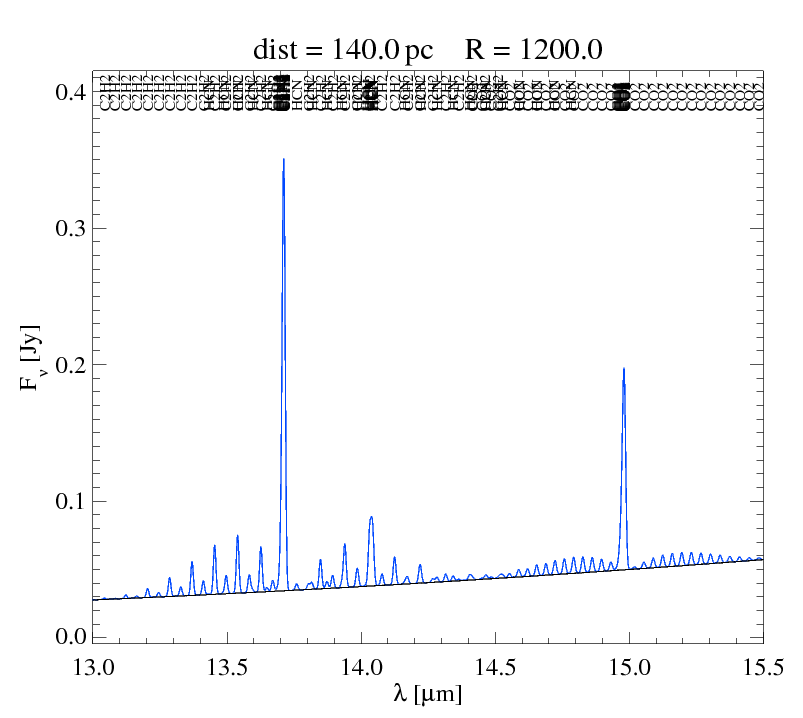
CO2, C2H2, HCNrovib, NH3 lines between 9 and 12 microns, and OHrovib LTE lines are now included in ProDiMo (17 July 2012) using spectroscopic data from the HITRAN database. The strongest lines are between 13 and 15.5 microns as seen by Spitzer. Be aware that no ray-tracing is available for these LTE transitions at the moment. Be aware that the strong Q-branches require overlapping-line radiative transfer, which is not implemented in ProDiMo yet. Also the cooling by lines with LTE population is most likely overestimated by factor up to few hundreds because of subthermal population.
See also Slab models for a complementary description of HITRAN transitions.
Update 23 Aug 2012: the vibrational population is calculated in NLTE in a crude 2-pseudo level. The rotational levels are still in LTE. The line fluxes are now down by a factor 10-100.
The line flux estimates are in Fline_estimates.out.
To include the lines as gas coolant (ie include them as part of the gas heating/cooling balance), you need to set to .true. the swithcs in Parameter.in
.true.  ! CO2_LTE_cooling
.true.  ! C2H2_LTE_cooling
.true.  ! HCNrovib_LTE_cooling
.true.  ! OHrovib_LTE_cooling
.true.  ! NH3rovib_LTE_cooling
The datafiles are located in /data/HITRAN2009/, and are called *.par
For developers, the following are include files
BD_ISO_2002.for  BD_ISO_82_to_85.for  BD_MOL.for  BD_TIPS_2003.for
ISOTOPS_2002.CMN  MOLEC.CMN  SPECIES_2002.CMN