Multiple Zones
So-called multiple-zone disk models allow to set certain disk parameters differently for each radial zone. A normal disk model has simply one zone only. ProDiMo allows to define up to 4 different radial zones, where those zones can be connected or separated by (empty) gaps. To activate a multiple-zone model, use e.g. NZONES = 2 in Parameter.in, and then start specifying the zone-specific parameters.
Note that the default names (those used for single zone model) of the parameters (e.g. Rin, Rout, Mdisk, etc.) belong to the first zone, which is the outermost zone, as it usually contains the overwhelming majority of the disk mass. Zones 2, 3, 4 are then spatially ordered inside-out, i.e. the second zone is the innermost zone.
zone2 ... [zone 3 ... [zone4 ...]] zone1where "[]" means you can omit.
Zone-specific parameters
List of all the parameters that can be defined zone-specifically. The name before the ( ) is the "base" name of the parameter, and sets the value for zone1 as defined above, and also the default value for the other zones. The names within ( ) are the zone specific names. Please note some parameters have a specific name for zone1 (in that case 4 parameter names are listed within ( ) )
Structure
- Mdisk (M2disk, M3disk, M4disk): the gas mass contained in that zone
- Mdust (M2dust, M3dust, M4dust): the dust mass contained in that zone
- Rin (R2in, R3in, R4in): the inner radius of that zone
- Rout (R2out, R3out, R4out): the outer radius of that zone
- dust_to_gas (d2ust_to_gas, d3ust_to_gas, d4ust_to_gas): Dust-to-gas mass ratio in that zone
- epsilon (e2psilon, e3psilon, e4psilon): the surface density gradient
- MCFOST_H0 (MCFOST_H2, MCFOST_H3, MCFOST_H4): in case a zone is MCFOST_LIKE parametric: scale height
- MCFOST_BETA (MCFOST_B2, MCFOST_B3, MCFOST_B4): in case a zone is MCFOST_LIKE parametric: flaring index
- MCFOST_RREF (MCFOST_R2, MCFOST_R3, MCFOST_R4): ref. radius for the MCFOST_LIKE parametric zone structure
- zone1_hs (zone2_hs, zone3_hs, zone4_hs): specify whether the vertical structure of that zone is to be calculated in hydrostatic equilibrium (=1) or MCFOST_LIKE parametric (=0)
- raduc (r1aduc, r2aduc, r3aduc, r4aduc): smoothing parameter for the inner edge of each zone
- reduc (r1educ, r2educ, r3educ, r4educ): smoothing parameter for the inner edge of each zone
Dust properties
- amin (a1min, a2min, a3min, a4min): minimum dust grain size
- amax (a1max, a2max, a3max, a4max): maximum dust grain size
- dust_settle (d2ust_settle, d3ust_settle, d4ust_settle): dust settling parameters
- a_settle (a2_settle, a3_settle, a4_settle): settling parameter for the dust size distribution
Chemistry
- fPAH (f2PAH, f3PAH, f4PAH): the PAH-abundance
- CtoO (C1toO, C2toO, C3toO, C4toO): carbon to oxygen elemental abundance ratio
- CtoN (C1toN, C2toN, C3toN, C4toN): carbon to nitrogen elemental abundance ratio
- CtoS (C1toS, C2toS, C3toS, C4toS): carbon to sulphur elmental abundance ratio
TODO: link to a page with more details on the parameters (single zone) if it exists
In contrast, other parameters are global, i.e. valid for all zones, in particular
- dust material, size and opacity parameters NDUST apow
- options for hydrostatic equilibrium like MCMAX_LIKE
- dust settling method settle_method
- the tapering-off parameter Rtaper
Example 1
------ disk shape ------
.true.      ! MCMAX_LIKE         : assume cT2=kTdust/(2.3*amu)
.true.      ! MCFOST_LIKE        : mixed case
.true.      ! solve_diskstruc    : mixed case
40.0        ! beta_max
10.0        ! MCFOST_RREF [AU]
2           ! NZONES
2           ! settle_method      : dust settling (Dubrulle et al. 1995)
------ outer zone ------
140.0       ! Rin       [AU]     : inner radius of outer disk
300.0       ! Rout      [AU]     : outer disk radius
0.02        ! Mdisk     [Msun]   : disk mass
1.0         ! epsilon
1           ! zone1_hs           : zone 1 in hydrostatic equilibrium
0.01        ! dust_to_gas
0.01        ! fPAH
1.E-3       ! a_settle           : alpha for Dubrulle-settling
------ inner zone ------
0.25        ! R2in      [AU]     : inner disk radius
30.0        ! R2out     [AU]     : outer radius of inner disk
1.0E-6      ! M2disk    [Msun]   : disk mass
0.5         ! e2psilon
0           ! zone2_hs           : zone 2 parametric
1.1         ! MCFOST_H2
1.0         ! MCFOST_B2
0.01        ! d2ust_to_gas
0.01        ! f2PAH
1.E+99      ! a2_settle          ; zone 2 not settled
------ dimensions ------
40          ! NXX
30          ! NZZ
1.0         ! NXratio            : ratio of x-gridpoints fist/last zone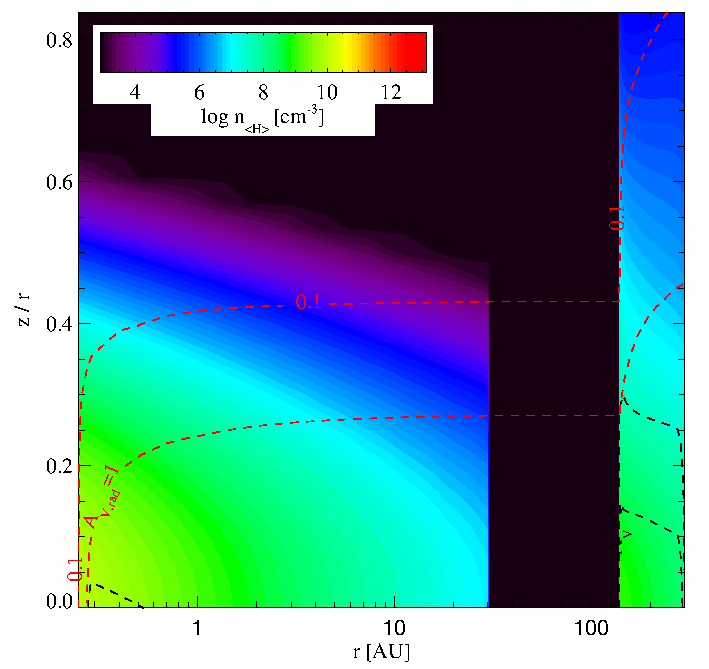
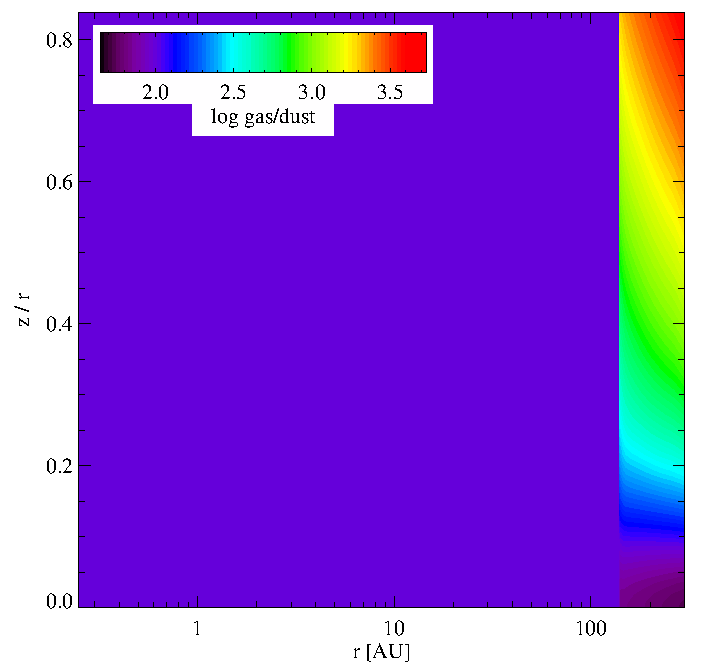
The figures show the results for this setup: an inner (second) parametric zone up to 30 AU, then a gap up to 140 AU, and finally the outer (first) zone which is calculated in MCMAX_LIKE hydrostatic equilibrium and Dubrulle-settling alpha=1.E-3. Note the special parameter NXratio here. Because the outer zone is so little extended in log(r) in comparison to the inner zone and the gap, it would get only very few x-gridpoints. By setting NXratio=1 we specify that the outer zone should have the same number of gridpoints as the inner zone.
Also note that, in this "mixed" example, we must specify zone1_hs and zone2_hs, as well as setting both solve_diskstruc=.true. and MCFOST_LIKE=.true..
Example 2
------ disk shape ------
.false.     ! solve_diskstruc   : solve the vertical hydrostatic eq.?
.true.      ! MCFOST_LIKE       : fixed disk structure like in MCFOST?
10.0        ! MCFOST_RREF [AU]  : reference radius
2           ! NZONES
------ outer zone ------
0.03        ! Mdisk     [Msun]  : disk mass
50.0        ! Rin         [AU]  : inner radius of outer zone
900.0       ! Rout        [AU]  : outer disk radius
1.0         ! epsilon      [-]  : column density power law index
0.8         ! MCFOST_H0   [AU]  : scale height at reference radius
1.15        ! MCFOST_BETA       : flaring power index
0.01        ! dust_to_gas  [-]  : dust/gas mass ratio
0.05        ! fPAH         [-]  : PAH abundance with respect to ISM
------ inner zone ------
3.E-5       ! M2disk            : disk mass in inner zone
0.4         ! R2in              : disk inner radius
0.5         ! e2psilon
0.5         ! MCFOST_H2
0.8         ! MCFOST_B2
0.005       ! d2ust_to_gas      : more gas in zone 2
1.E-7       ! f2PAH             : no PAHs in zone 2
Note that, in this example, R2out is not specified, so ProDiMo sets it equal to beginning of the next zone, that is Rin. Hence, in this example, the outer zone (zone 1) stretches from Rin=50AU to Rout=900AU whereas the inner zone (zone 2) stretches from R2in=0.4AU to R2out=50AU.
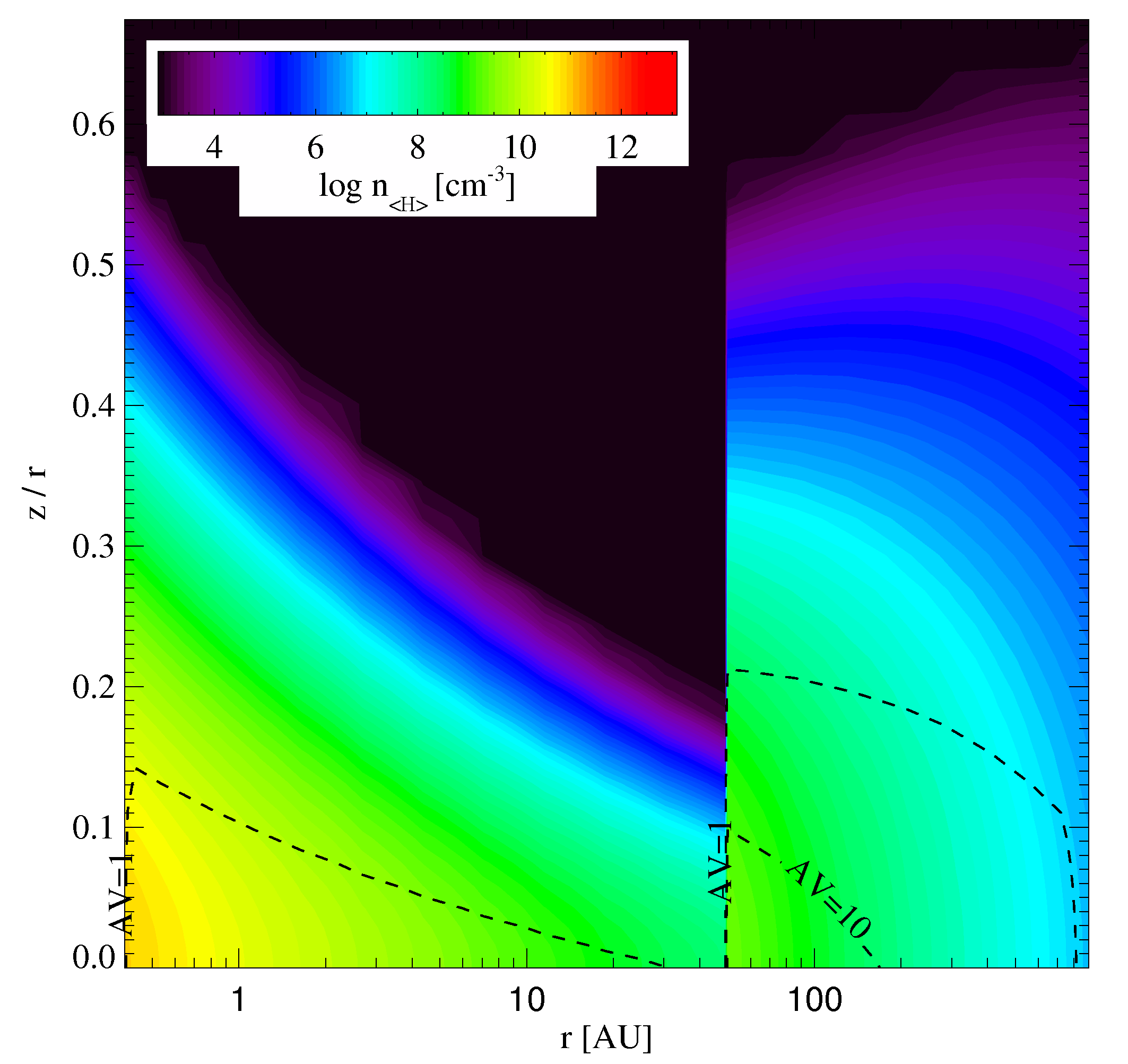
If you do specify, in addition, R2out, for example 10AU, there will be a gap between 10AU and 50AU. It is worth to have a look at the stdout file saying ...
DISK_STRUCTURE: ...
 COLDENS: const =   1.00149144801549
           1  0.400000000000000       7.355894603900901E+023
           2  0.402976849043001       7.328674705626389E+023
           3  0.411907396172003       7.248793009276428E+023
           4  0.447629584688010       6.953542326700778E+023
           5  0.508007436761047       6.527253182337970E+023
           6  0.587212757965528       6.071105115501055E+023
           7  0.695678582696035       5.577777383562828E+023
           8  0.853292858592467       5.036356198454087E+023
           9   1.10324650601911       4.429239999687171E+023
          10   1.56030363588363       3.724439580923650E+023
          11   2.66392422738579       2.850391799222106E+023
          12   4.52278103407148       2.187573795924329E+023
          13   7.67872752230288       1.678884676106903E+023
          14   10.0000000000000       1.471178920780180E+023
          15   10.1000000000000        113330187490890.
          16   17.1559978114959        66719225907745.8
          17   29.1414119710946        39278635324649.2
          18   49.5000000000000        23123937245616.0
          19   50.0000000000000       2.289269787315982E+023
          20   50.8625308240699       2.250448169040598E+023
          21   53.4501232962797       2.141500941565952E+023
          22   76.0901115827078       1.504314910109976E+023
          23   108.319770350687       1.056718353401431E+023
          24   183.904105800273       6.224085583500281E+022
          25   280.865490287933       4.075384599526815E+022
          26   405.737252313020       2.821123490960410E+022
          27   552.262435051422       2.072628556659683E+022
          28   704.423021669882       1.624925447417317E+022
          29   834.674664412046       1.371354543826107E+022
          30   900.000000000000       1.271816548508879E+022
which states the radii and vertical column densities at ProDiMo's x-gridpoints. This demonstrates how ProDiMo puts the x-gridpoints: One point exactly at 10AU (with large column density), one point just behind (small), one just before the next wall (small) and one exactly at 50AU (large), then a few points with very small increase of radius.
Example 3
A special 2-zone case is implemented, if you only specify e2psilon, MCFOST_H2, and a negative value for M2disk. ProDiMo will then auto-adjust M2disk and MCFOST_B2 to produce a smooth density transition between zone 1 and zone 2 at R2out=Rin.
------ disk shape ------
.false.     ! solve_diskstruc
.true.      ! MCFOST_LIKE
0.1         ! MCFOST_RREF [AU]
2           ! NZONES
------ outer zone ------
0.8         ! Rin       [AU]     : inner radius of outer disk
200.0       ! Rout      [AU]     : outer disk radius
0.007       ! Mdisk     [Msun]   : disk mass
1.76        ! epsilon
0.0032      ! MCFOST_H0
1.12        ! MCFOST_BETA
------ inner zone ------
0.07        ! R2in      [AU]     : inner disk radius
-1.0        ! M2disk    [Msun]   : auto-adjust zone2
1.76        ! e2psilon
0.0032      ! MCFOST_H2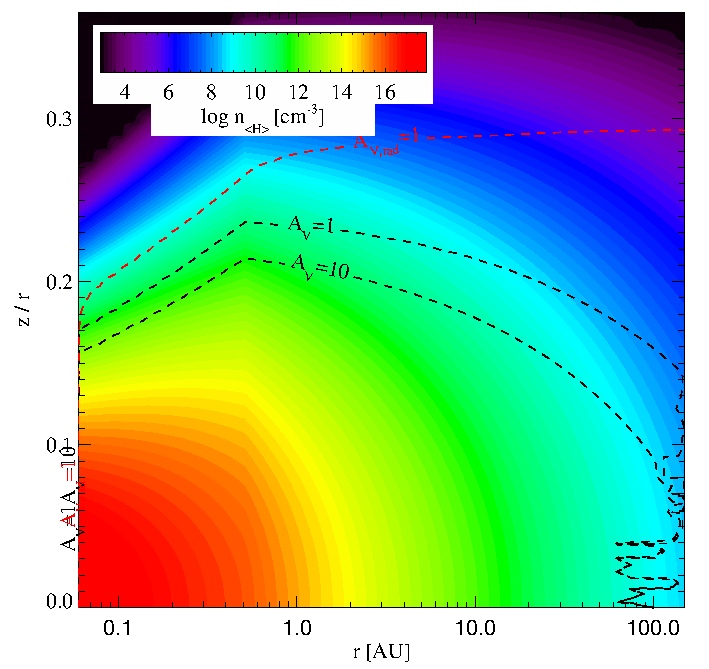
Example 4
Another special case is implemented for 3 zones. If you set M3disk negative, the sandwich zone 3 will fill the space between zone 2 and zone 1 (from R3in to Rin), and the 4 parameters M3disk, e3psilon, MCFOST_H3 and MCFOST_B2 will be auto-adjusted to give a smooth transition, such that (at all vertical heights), the densities are continuous across the zone transitions 2->3 and 3->1. Here is one example
------ disk shape ------
.false.     ! solve_diskstruc   : solve the vertical hydrostatic eq.?
.true.      ! MCFOST_LIKE       : fixed disk structure like in MCFOST?
10.0        ! MCFOST_RREF [AU]  : reference radius
300.0       ! Rtaper      [AU]  : radius where disk start to taper off
3           ! NZONES
------ outer zone ------
110.0       ! Rin         [AU]  : inner radius of outer zone
600.0       ! Rout        [AU]  : disk outer radius
0.1         ! Mdisk      [Msun] : gas mass outer zone
0.99        ! epsilon           : column density power law index
1.235       ! MCFOST_H0   [AU]  : scale height at 10AU
1.08        ! MCFOST_BETA       : flaring power
0.0056      ! dust_to_gas
0.0086      ! fPAH
------ inner zone ------
0.3         ! R2in        [AU]  : disk inner radius (zone 2)
5.E-7       ! M2disk     [Msun] : gas mass inner zone
0.22        ! e2psilon
0.84        ! MCFOST_H2
0.88        ! MCFOST_B2
0.01        ! d2ust_to_gas
0.0001      ! f2PAH
------ sandwich zone ------
2.5         ! R3in        [AU]  : inner radius of zone 3
-0.1        ! M3disk            : auto-adjust zone 3
0.01        ! d3ust_to_gas
0.0001      ! f3PAH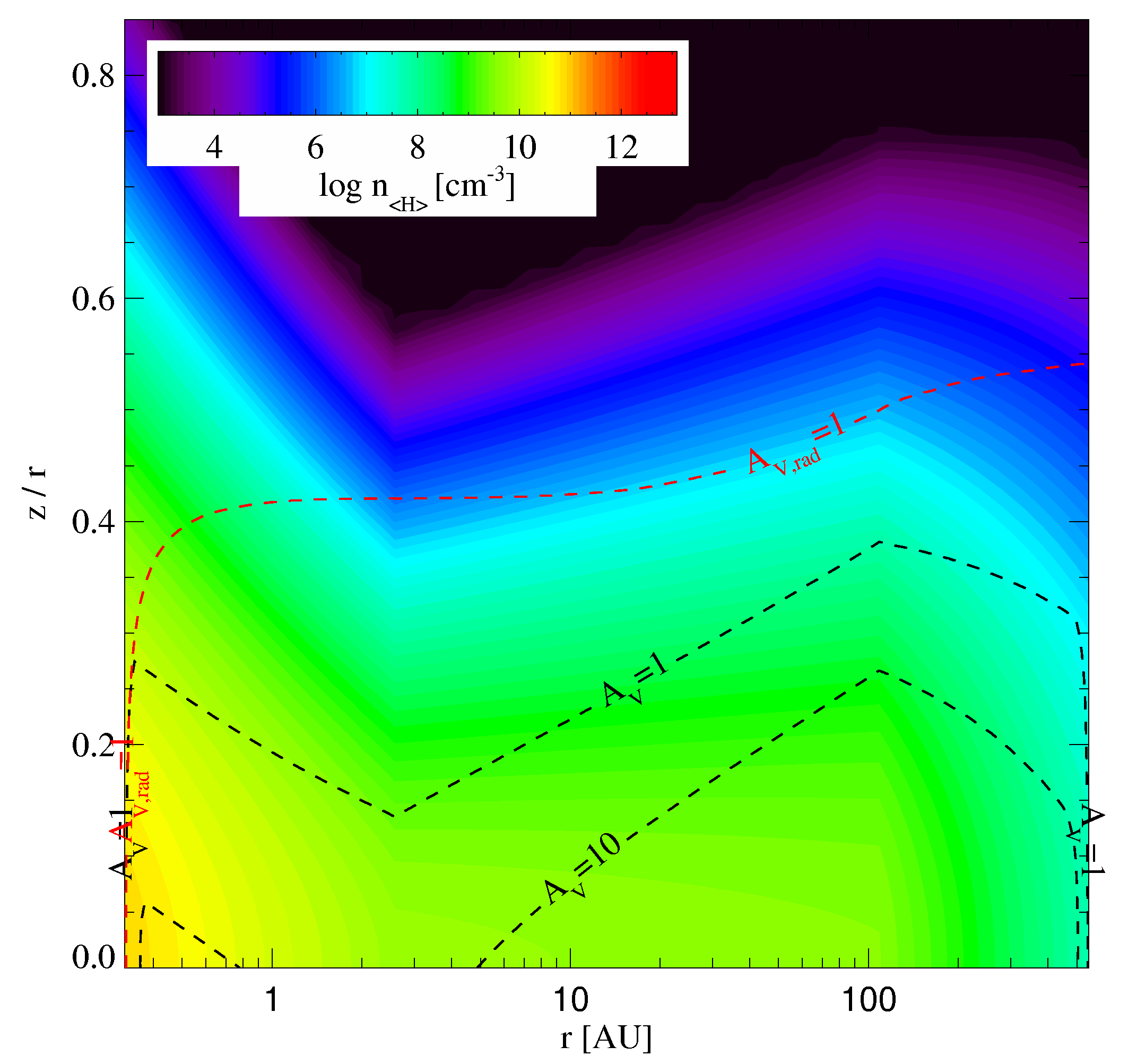
The FORTRAN subroutines smooth_2nd_zone.f and smooth_3rd_zone.f are currently programmed in such a way that they will produce continuous (unsettled!) dust densities. So, if you set d3ust_to_gas different from dust_to_gas, the gas densities will be discontinuous anyway. One could change this behaviour (to have continuous gas but discontinuous dust) by putting smooth_dust=.false. in e.g. smooth_3rd_zone.f.