How to set the spatial grid resolution
In Parameter.in, there are a number of parameters which tell ProDiMo how to distribute the spatial grid points (xi,zj)
100         ! NXX
60          ! NZZ
15          ! Ninner
10          ! NnewWall
1.0         ! NXratio
NXX is the total number of r-gridpoints xx(ix), and NZZ the total number of z-gridpoints zz(ix,iz). The z-gridpoints are aligned on radial rays such that zz(ix,iz)/xx(ix)=const(iz) for all ix.
Ninner is the number of r-gridpoints used to refine the inner rim, which is important to get correct results for the near-IR excess and, in particular, for spectral lines that are directly emitted from the inner rim.
NnewWall is the number of r-gridpoints used to refine subsequent inner walls of outer disk zones (meaningless for NZONES=1). Again, this is important to resolve the continuum and line emission coming directly from secondary walls.
NXratio is the ratio of the number of r-gridpoints (before refinements) used for the inner zone devided by the number of r-gridpoints (before refinements) used for the outer zone. By changing NXratio, you can tell ProDiMo to use more or less r-gridpoints for your radial zone of interest, if there are at least 2 zones.
IMPORTANT
Grid resolution is often more important then you think it is. The figure below shows some results as function of radial and vertical grid size:
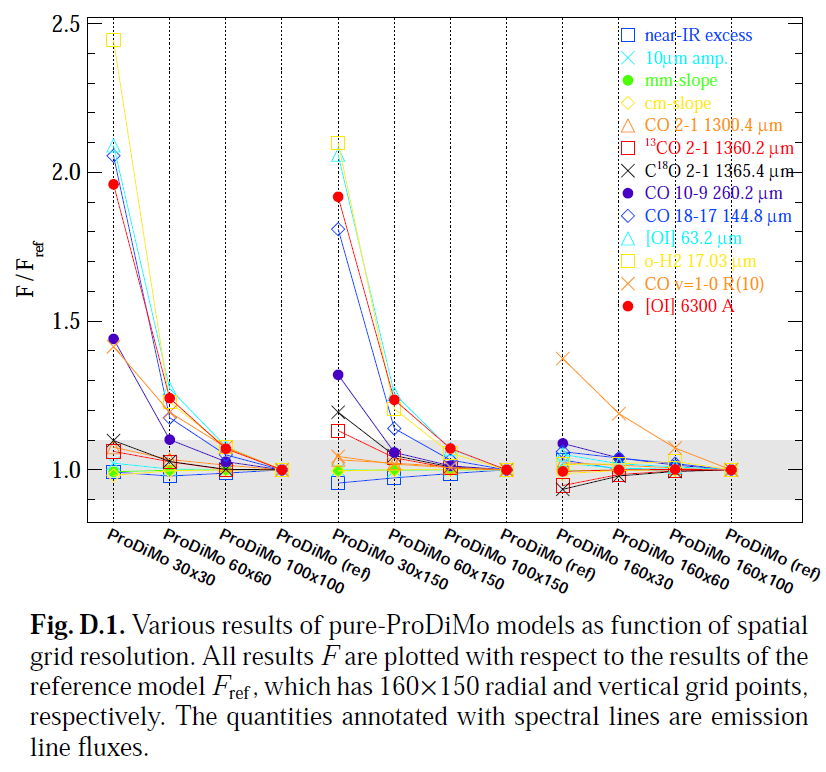
Even quick 30×30 models are sufficient to predict the SED and derived quantities, with an accuracy better than 5% with respect to the results from the big 160 × 150 reference model. However, the grid resolution is critical when studying emission lines. A too coarse spatial grid usually leads to an over-prediction of the emission line fluxes. Most critical are lines which originate in a small portion of the disk volume, like the weak o-H2 and high-J CO lines, but also [OI] 63.2 μm and [OI] 6300Å. Here, the radial grid resolution is more important than the vertical grid resolution. I would recommend at least NXX=100 for publications.
In particular, we discovered that insufficient wall resolution may result in a substantial overprediction of spectral lines that are emited directly from the surface of the inner or secondary walls.
We need to resolve radially how UV continuum and UV resonance lines penetrate radially into the (inner or secondary) wall, and we need to resolve the line formation region around tau_radial_line~1 at the same time. This is a numerical challenge! We figured out that we sometimes need a radial grid resolution of about 1m (!) at the inner rim (corresponding to tau_line_UV ~ 1).
If you have a model which shows very strong emission lines which are apparently emitted just from the inner rim, or just from the inner wall of an outer zone, but not vertically, please be very careful. I would recommend to run additional tests with line_transfer=.true. and
inner rim:
----------
try Ninner=25        (default=4)

inner wall of outer disk:
-------------------------
try NnewWall=15      (default=5)
If you do see large effects when playing with those parameters, please contact us for further advice.
Peter Woitke 06/03/2015