Fitting stellar parameters
Once you have compiled your SEDobs.dat (and UV.dat if available), and the distance d[pc] is known, you can fit your stellar and reddening parameters (Teff, Lstar, EB-V) to the observational data. First of all, check your SEDobs.dat carefully, and investigate each data point. You can activate or de-activate photometric points by putting in the rem-column "ok" (=valid point), "ul" (=upper limit) or "??" (=questionary point). Then, compile and link some code as follows
> cd /path/to/ProDiMo/src_starfit
> make
> cd /path/to/ProDiMo/MyObject
> ln -s /path/to/ProDiMo/src_starfit/star_fit .
Next, create and edit an Evo.in in that directory as
1.8         ! Mstar[Msun]
145.0       ! distance[pc]
0.0, 1.1    ! powerlaw UV excess? fUV,pUV
3.1         ! Rv
0.1, 1.0    ! lmin,lmax[mic]
    0   200 3
0.1
8200    200    0    Teff
11.2    1.0    1    Lstar
0.066   0.01   1    Ebv
First two lines contain stellar mass Mstar[Msun] and distance d[pc], next line has parameters to add a powerlaw UV-excess (put "0.0, some number" to switch off). Then comes the reddening parameter RV (standard value is 3.1). The next line contains the minimum and maximum wavelengths where the comparison between observations and data (photometry and UV spectrum) is evaluated, resulting in a chi2 value. Be careful! The UV (<0.2mic for Herbig AE/Be, and <0.5mic for CTTS) is often contaminated by non-photospheric emission due to stellar activity, accretion, etc., and the infrared part (>1mic for non-transitional discs) can easily be contaminated by to the presence of hot dust in the disc.
Next comes a line with start and end generation number, and the number of parameters to fit. Next line is the stepsize. Last 3 lines contain starting value, typical variation width, a switch, and the name of the parameter to be optimized. The switch is for linear (0) or logarithmic (1) variation. If everything is in place, type ...
> cd /path/to/ProDiMo/MyObject
> ./star_fit
The screen should now contain detailed informations about how your fit is working, finally asking "start evolutionary strategy? (y/n)". Press "n" and change last three lines in Evo.in to improve the fit by hand. You can visualize the fit with
> cd /path/to/ProDiMo/MyObject
> idl
IDL> .r SED_star
IDL> exit
> gv SED_star.ps
The plot will show the REDDENED MODEL in comparison to the observations. If your fit looks halfway decent, answer "y", and star_fit will apply a genetic algorithm to automatically improve the fit.
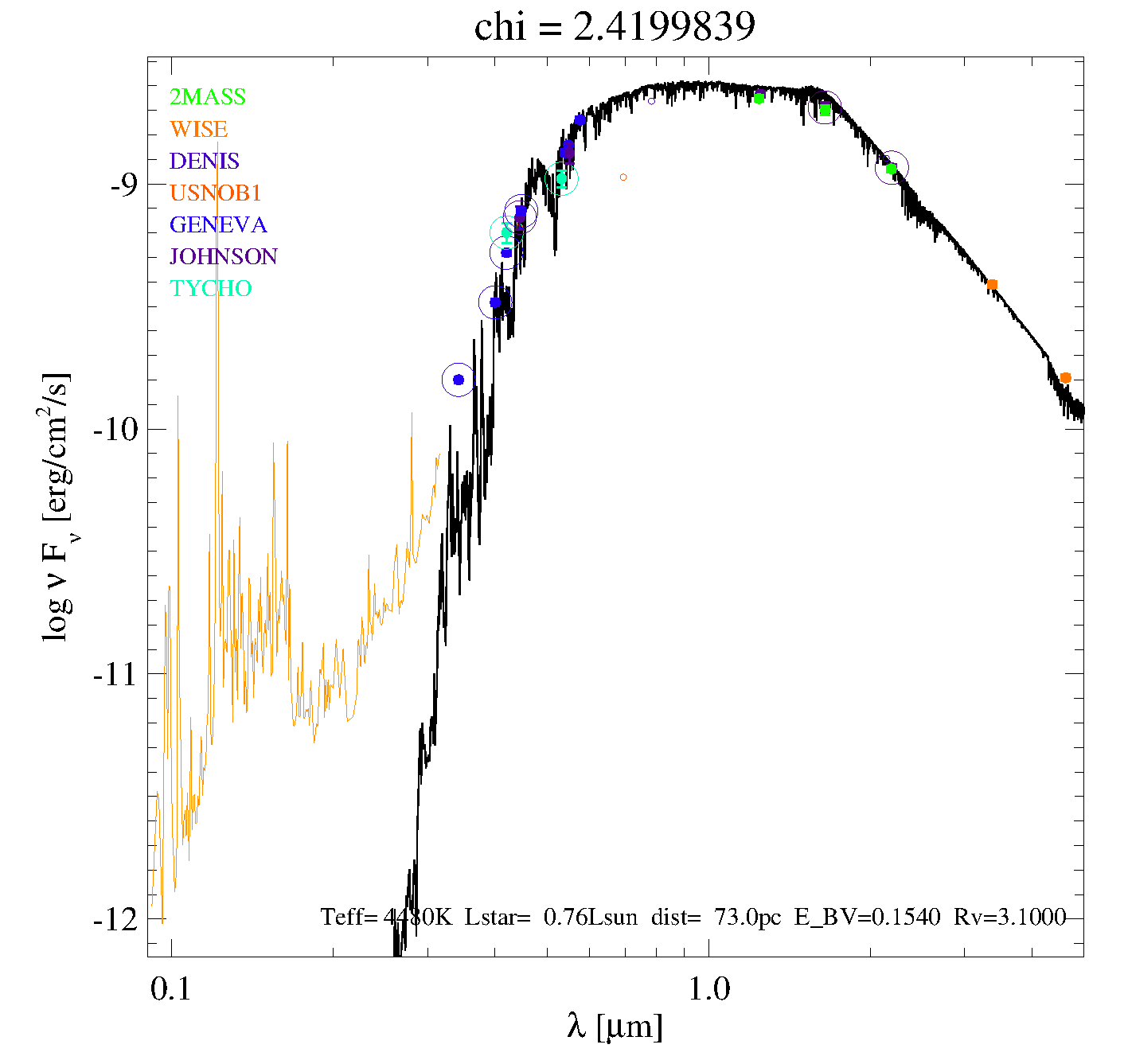
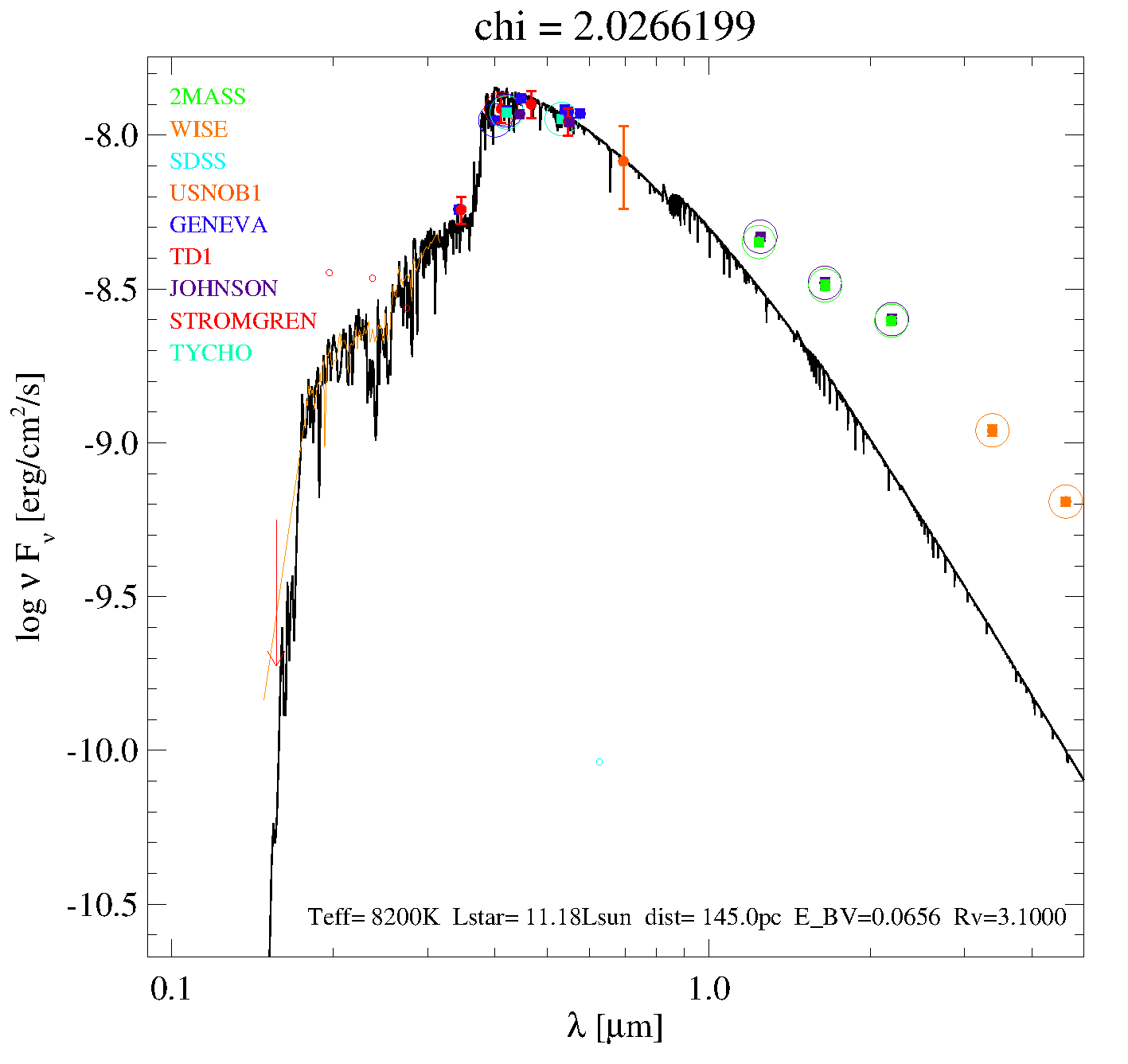
These examples show successful fits of stellar parameters after the genetic algorithm has finished. Left is V4046 Sgr, and right is HD 169142. The K-type CTTS on the l.h.s. is of transitional type but UV-active, so I fitted the data from 0.5mic to 5mic. The HerbigAe (actually F-type) on the r.h.s. seems to have not much non-photospheric UV, but hot dust, and thus is fitted from 0.1mic to 1mic.
Once you have a good fit of stellar parameters, you might want to determine age and mass of the star from the Siess evolutionary tracks accessible via http://www.astro.ulb.ac.be/~siess/WWWTools/HRDfind. You can use the resulting stellar mass to improve it's estimate in Evo.in, and run the fit all over again.
Have fun.
Peter Woitke, Jun1 18, 2012