ProDiMo with custom large CO levels
TODO: I think it is not up-to-date (i.e. Wing-Fai's paper, what is the current default etc. )
Motivations
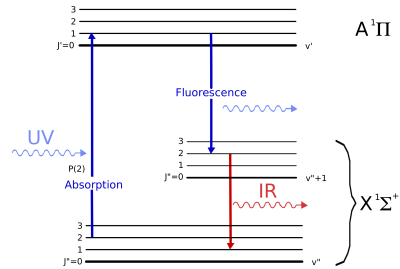
The observation of CO ro-vibrational emission lines up to very high vibrational level from discs around Herbig Ae stars (e.g., van der Plas et al. 2009, A&A, 500, 1137; Brittain et al. 2007, ApJ, 659, 685) prompted us to model the effects of fluorescence pumping from the ground X1Σ+ to the electronic A1Π level. We implemented a CO model molecule that includes up to 120 rotational levels within 9 vibrational levels for the ground and A-excited states in the radiative-photochemical code ProDiMo. We took CO collisions with H2, H, He, and electrons into account. We estimated the missing collision rates using standard scaling laws and discussed their limitations. We tested the effectiveness of UV fluorescence pumping for the population of high-vibrational levels (v=1–9, J=1–50) for two typical Herbig Ae discs with masses of 10−2 M⊙ and 10−4 M⊙ respectively. UV fluorescence impacts on the population of high-rotational levels (J >20) and high-vibrational levels (v >2). The effect is more acute for low density gases because of lower collisional de-excitations. Excitation temperatures derived using optically thick 12CO lines are inaccurate.
ProDiMo implementation
To compute the CO ro-vibrational level population by default ProDiMo uses the datafile: /data/COvibrot_LAMBDA.dat (4 vibrational levels). By default, ProDiMo will not take UV-fluorescence pumping into account.
New routines have been implemented to improve the completeness of collision rates connecting the ground electronic-state ro-vibrational levels.
The files init_CO_rovib.f and bvls.f90 contain the routines to initialise the CO molecule number of rotational, vibrational,and electronic levels as the user wishes. You may need to increase the values of Nlevmax, Nlinemax, and Ntransmax in dataNLTE.f if you wish to model many rovibronic levels. This is an example that has relatively large values:
      integer,parameter :: Nlevmax=1500      ! number of levels
      integer,parameter :: Nlinemax=24000    ! number of lines
      integer,parameter :: Nchemmax=500      ! number of chem. exc. rates
      integer,parameter :: Ntransmax=1000000 ! number of coll. trans.
Increasing these values may result in a segmentation fault because of lacking stack-memory, see Known_Problems to see how to increase stacksize. The switches in Parameter.in are:
----- CO rovibration ----
.true.      ! custom_COrovib
60          ! COX_Nrot
6           ! COX_Nvib
6           ! COA_Nvib
The default value of custom_COrovib is false and ProDiMo will use the currently available CO level file. COX_Nrot is the number of rotational levels for the ground (X-state) and excited (A-state) electronic levels (same value). COX_Nvib is the number of vibrational levels in the X-state, COA_Nvib is the number of vibrational levels in the A-state. Currently COX_Nrot is limited to 141, COX_Nvib to 21 and COA_Nvib to 10. CO_A_state_levels will extrapolate existing collision rates within all the rovibrational levels in the ground state. There is no collisions within the A-state levels nor radiative transitions. Only transitions between X and A are possible to model possible UV-fluorescence effects. By setting COA_Nvib to 0, ProDiMo will only consider transitions in the ground electronic state. In the example above the total number of levels is (6+6)x60=720.
Warning! The size of the CO model depends on the amount of memory you have and that you give to ProDiMo. You also may have to further increase the maximum dimensions in dataNLTE.f as shown above.
In the next example, it's a pure ro-vibrational model with a number of levels of 800:
----- CO rovibration ----
.true.      ! custom_COrovib
100         ! COX_Nrot
8           ! COX_Nvib
0           ! COA_Nvib
.true.      ! gbar
.true.      ! Voigt_escape
If CO overtone emission is studied, then COX_Nrot should be greater than ~100. One should keep in mind that the speed in solving a filled n-level system is ~n3 in the worst case.
A ProDiMo example can be found at /input_examples/large_CO_molecule. The fastest solver is the LAPACK solver, which uses optimised matrix-matrix multiplication routines.
The Sparse Matrix solver can also be used. Acceleration is not guaranteed.
The electronic collision rates are determined using the Born approximation for dipolar(J->J+/-1) and quadrupolar (J->J+/-2) transitions. The computation is triggered by the gbar switch.
If electronic transitions are included, the user needs to switch the Voigt_escape on. See Voigt_profile_escape_probability
The code will generate a Lambda-style spectroscopic and collisional rate file named: COvibrot_Lambda_nelec2_nvib4_nrot45.dat, where the number of electronic, vibrational,and rotational levels are given in the name.
The switch
.true. ! COrovib_sensitivity_analysiswill generate fake collisional rates in the same order of magnitude than the actual rates. The aim is to study the sensitivity of the CO line fluxes on the adopted rates. The program will add the suffix _sens_analysis to the datafile.
The option will call a routine that will combine existing rates (CO pure rotational rates from the Lambda database: CO_Lambda.dat), new vibrational rates and extrapolations.
Warning! The indices for line transfer should be read from the
LineList.outand used with the switch.true. ! immediate_lines.
CO UV fluorescence pumping
A paper has been submitted to A&A, which explains the the choice of the collision rates and the influence of the UV-pumping on the high-v CO rovibrational levels.
CO spectroscopic data
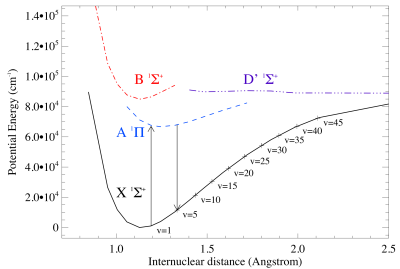
Tashkun et al. (2010, JQSRT, 111, 1106) compiled and evaluated existing experimental frequencies for transitions within the ground electronic state. Their work is based on accurate experimental frequency measurements. We compared their energy levels and frequencies with those from Chandra et al. (1996, A&AS, 117, 557) and found no significant differences. In addition Chandra et al. (1996) computed Einstein spontaneous probabilities A1Π for all ro-vibrational transitions between 140 rotational levels and 10 vibrational levels at the ground electronic state. We adopted their transition probabilities, which compared well with other studies (e.g. Okada et al. 2002, JQSRT, 72, 813). The transitions between the electronic excited ro-vibrational level A and the ground ro-vibrational level X 1Σ+(4th positive system), which occur around 1600Å, were derived from the band-averaged transition probabilities of Beegle et al. (1999, A&A, 347, 375) and Borges et al. (2001, J. Mol. Spec, 209, 24) using the formula and Höln-London factors in Morton & Noreau (1994, ApJS, 95, 301). The lower-left figure below shows the CO potential energy curves for the difference ground and electronic excited levels. The lower-right figure illustrates the UV-fluorescence pumping.
CO collisional data
The lack of completeness of any individual study obliged us to use extrapolations and scaling laws to fill the missing collisional rates. Since protoplanetary discs show large varieties of physical and chemical properties we need to consider collisions of CO with H (Balakrishnan et al. 2002, ApJ, 568, 443), He (Cecchi-Pestellini et al. 2002, ApJ, 571, 1015; Krems et al. 2002, J. Chem. Phys., 116, 4525), H2 (Yang et al. 2010, ApJ, 718, 1062, Reid et al. 1997, J. Chem. Phys. 106, 4931), and electrons (Ristic et al., 2007, Chem. Phys., 336, 58, Randell et al. 1996, J. Phys., 29, 2049). To check for the effect of inaccurate rates on the CO level population, we performed a sensitivity analysis and found that variations within an order of magnitude in the rates are acceptable. Recently Flower published his own CO rovibrational rates with H2 for v=1-0 transitions. His rates are consistent with the ones used in ProDiMo.
13CO ro-vibrational emission
(Update 30/07/2013) Spectroscopic data for all ground electronic-state ro-vibrational levels up to v=10 from Chandra et al. 1996 have been included. The collision rates are assumed to be the same than for 12CO. The same number of rotational and vibrational levels than 12CO will be automatically included in the ProDiMo run. (Update 26/02/2014) The energy levels and frequencies are taken from Guelachvili et al. 1983. The corresponding Lambda file is C13Ovibrot_Lambda_nelec2_nvib7_nrot40.dat. The name will change as function of the requested number of levels. The 13CO levels are automatically included unless the following switch
.false. ! custom_13COrovibis set in the Parameter.in file.
C18O ro-vibrational emission
(Update 26/02/2014) Same than for 13CO. Data are from Chandra et al. 1996. The collisional rates are assumed the same than for 12CO. Both 13CO and C18O lines are automatically included in the calculation. ProDiMo will generate the Lambda file 18O_COvibrot_Lambda_nelec2_nvib7_nrot40.dat The same than for 13CO, the C18O levels are not taken into account if the switch:
.false. ! custom_C18OrovibBy default the C18O levels are included.
Other undocumented parameters
TODO: Description missing
31          ! COX_Nrot            : the next switch does not allow a higher number
.true.      ! CO_H_2015           : this is some other data
Reference (not complete)
- Lambda database http://home.strw.leidenuniv.nl/~moldata/CO.htm
- Chandra, S., Maheshwari, V. U., & Sharma, A. K. 1996, A&AS, 117, 557
- Flower, D.R. 2001, J. Phys. B, 34, 2731
- Guelachvili et al., Journal of molecular spectroscopy 98, 64
- Jankowski P., Szalewicz K. 2005, JChPh 123, 10, 104301
- Schoier, F.L, van der Tak, F.F.S., van Dishoeck, E.F., Black, J.H. 2005, A&A 432, 369
- Thi, W.-F. et al. 2013, A&A 551, 49 [http://arxiv.org/abs/1210.7654]
- Wernli M., Valiron P., Faure A., Wiesenfeld P., Jankowski P., Szalewicz K. 2006, A&A 446, 367
- Yang, B., Stancil, P.C., Balakrishnan, N.; Forrey, R. C. 2010, ApJ 718, 1062