Molecular shielding factors
The UV photorate of species j (photoionisation or photodissociation) is given by
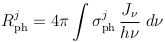 .
.
However, our continuum radiative transfer does not provide the required , it only provides the mean continuum spectral intensity
 ,
,
where this page explains how we split it into a radial and a vertical part (new_shielding=T is strongly recommended here, and is the default since v3.0). Molecular shielding factors are designed to capture the effects of molecular absorption of UV photons along the line of sight towards the UV source on the photorates. In ProDiMo, the traditional way to handle this problem is
0 ! newUVphoto : old treatment, using a few shielding factors from the literaturewhere we use a hand-selected set of published shielding factors to capture the most important selfshielding (j->j) and alien shielding (i->j) effects. These, in general, depend on temperature, because of line broadening and population of the lower molecular levels.
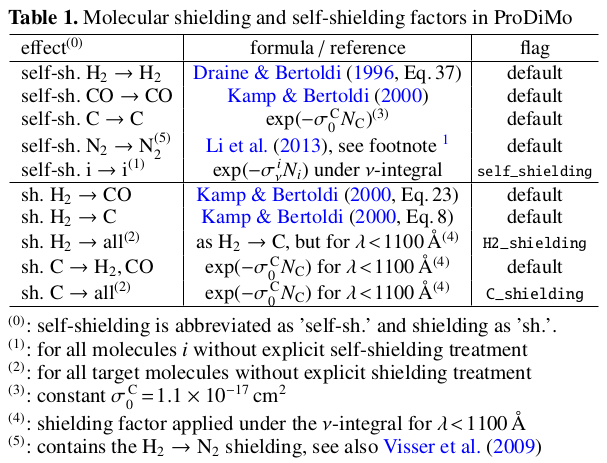
In general, we can write these dependencies as
 , (1)
, (1)
where Ni,rad and Ni,ver are the radial and vertical column densities of the absorbing molecules i, and T is the local gas temperature. The problem with this method is that only a very few shielding effects are captured this way. For example HCN is not shielded at all when newUVphoto=0, unless the user selects self_shielding and/or H2_shielding, in which case these shielding effects are estimated as if HCN had cross sections like neutral C.
Since ProDiMo v3.0, there are new options available to treat the molecular shielding, when the user selects newUVphoto>0. All previous switches, such as self_shielding, C_shielding, H2_shielding, HD_shielding, N2_shielding, etc., become meaningless in this case.
1 ! newUVphoto : self-calculation of shielding factorsThis method uses the molecular absorption cross sections, which we find as well in the Leiden photodissociation database, to calculate the photorates consistently with all mutual shielding effects in the following way
 , (2)
, (2)
where E2() is the second exponential integral function. In order to apply Eq.(2), we first bring all UV photo-cross-sections in ProDiMo on a common wavelength grid. This includes the PAHs and the molecules for which we only have (often guessed) photorates but no cross-sections, for which smooth cross-sections are generated during initialisation. This is conceptually the best and most precise treatment of all mutual shielding effects. However, analysis shows that the default low-resolution cross-section data (about 1 Angstroem wavelength grid, R=1000), although being perfectly fine to calculate the unshielded photo-rates, are insufficient to resolve the line overlaps in particular of the H2->H2 self-shielding. Therefore, ProDiMo offers another option UVphoto_highres=T (default =F). In that case, we use an internal R=70000 wavelength grid and read the high-resolution cross-sections from the Leiden database.
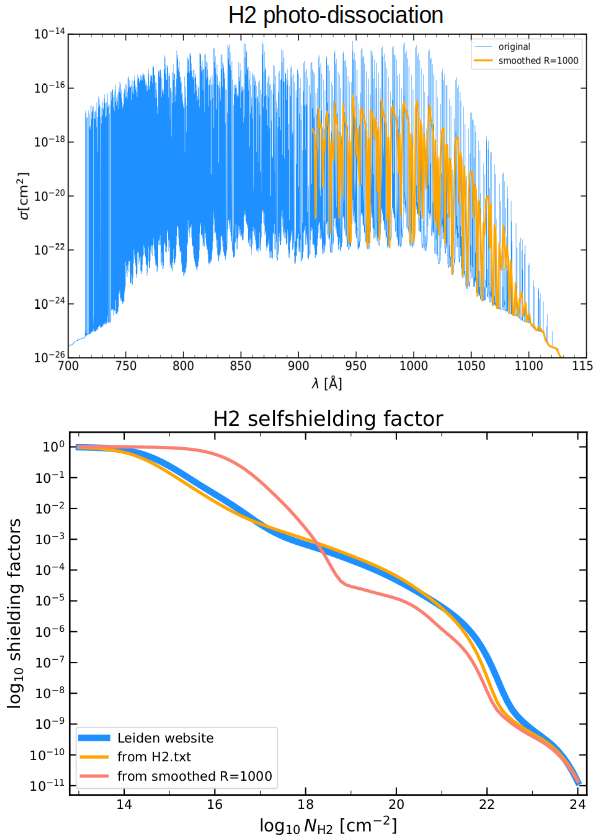
This figure shows that, when using the default 1A cross-section data (orange data in the upper plot), it is impossible to match the Leiden H2->H2 selfshielding factor (red and blue curves in the lower plot). However, when using the full data (blue data in the upper plot), we can reproduce the H2->H2 shielding factor (orange curve in the lower plot). The drawback of this method is that ProDiMo runs much slower with UVphoto_highres=T.
2 ! newUVphoto : using the Leiden shielding factorsIn this case, we use the tabulated shielding factors that are available on the Leiden photodissociation database. These include H2->j, H->j, j->j, C->j, N2->j and CO->j for all molecules j that have cross-section data in the Leiden photodissociation database.

We note that the Leiden shielding factors use a fixed temperature. We choose the src="ISRF" radiation field for all shielding factors. For HCN, for example, this method captures most of the relevant shielding effects, but does not include H2O->HCN and PAH->HCN shielding.
3 ! newUVphoto : hybrid method (recommended) The idea of this method is to use the tabulated Leiden shielding factors for the major shielding effects captured by these data, and to use self-calculation as described in the above section for all other shielding effects, for example H2O->HCN and PAH->H2, using the default R=1000 photo-cross sections. This has the advantage of having again a fast model. The other shielding molecules and PAHs mostly have low-resolution cross-section data anyway.
With the parameter debug_photo_rates=.true. an output file called "PhotoRates.out" is created. This file contains the unshielded photorate, the shielded photorate, and all shielding factors for each photoreaction, from which plots like these can be produced:
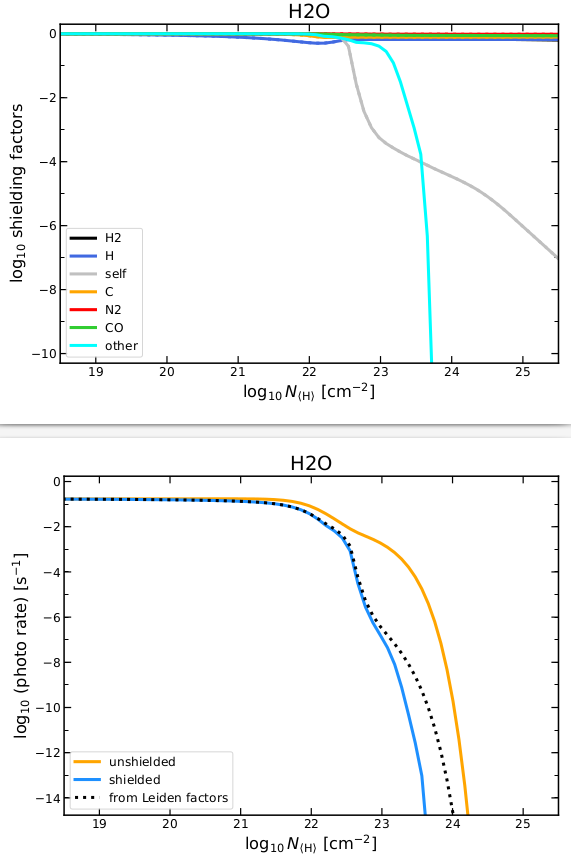
This plot shows results for H2O dissociation along a vertical cut with increasing vertical hydrogen nuclei column density N_H,ver. As we dive deeper into the disk, first the increasing radial shielding effects kick in, until that direction is blocked and it takes a little longer before the vertical shielding effects become relevant, too. Initially, H->H2O is important, before H2O->H2O selfshielding becomes more important. But eventually other (I guess vertical PAH) shielding effects are dominant.
The figure below shows a visualisation how the UV field between 912 and 2000nm penetrates the disk vertically at two selected radii, r=0.5AU and r=50AU, respectively:
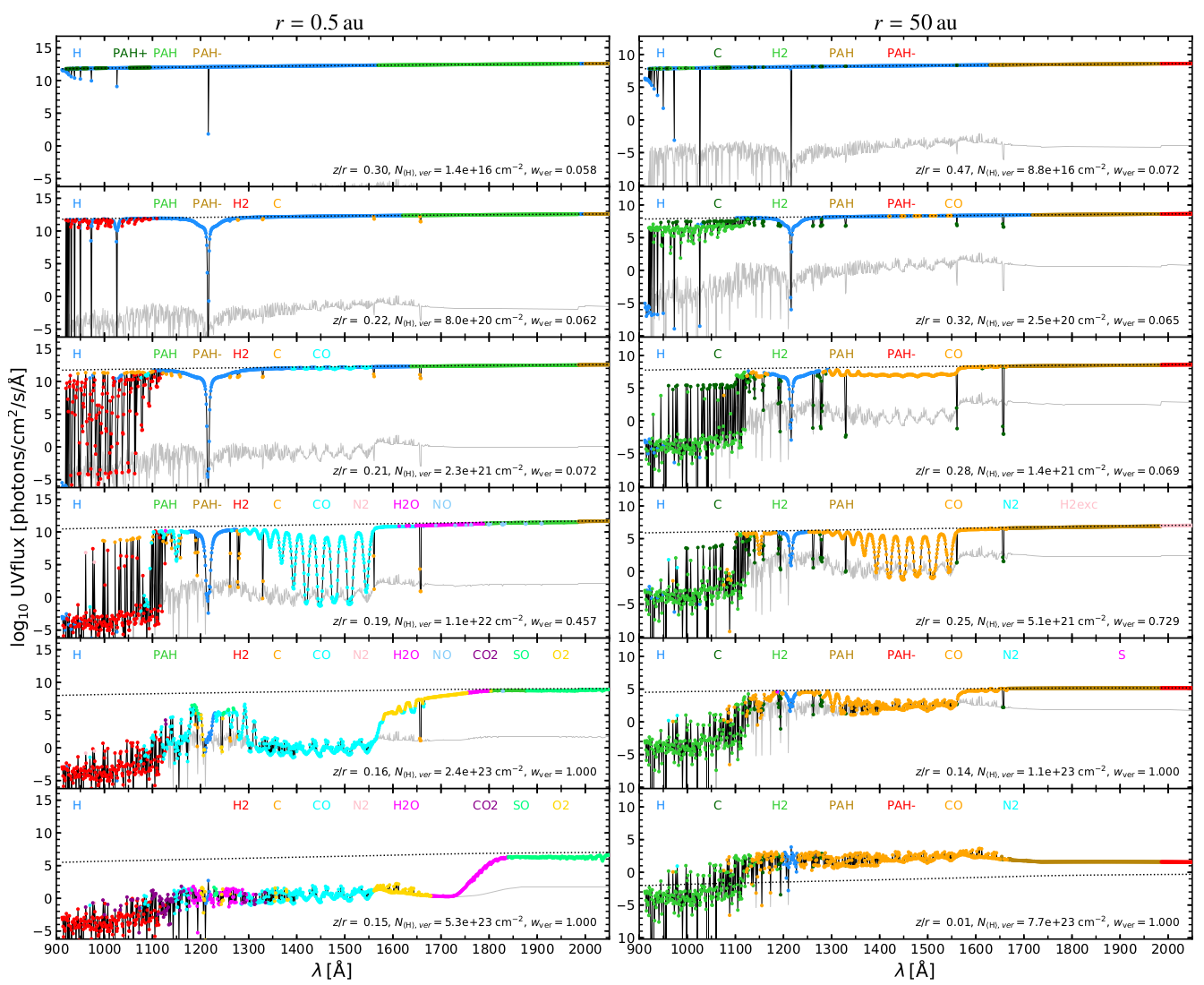
The dotted grey lines show the results of the dust continuum radiative transfer (with a powerlaw-UV input spectrum assumed for the star). From top to bottom, we see how the continuum mean intensity Jv^cont(r,z) is decreasing smoothly with vertical column density NH_ver as labelled, note that the y-axis spans 20 orders of magnitude.
The full black line is the result after molecular shielding, which first proceeds radially (w_ver<0.5) until a column density of about NH_ver=1.E+22 cm-2, beyond which it proceeds vertically (w_ver>0.5). At each height, we mark the most important molecular absorber by the colors. At low column densities, shielding by the Ly-series of H-atoms is most important, followed by H2 shielding and some C-atom shielding between the strong H2-lines. Subsequently, in the 115-155nm region, CO shielding gets important, partly at wavelengths at which the UV does not photo-dissociate the CO, but the CO-molecule absorbs these photons anyway. At longer wavelengths (>155nm), O2, H2O and PAHs are most effective.
At larger column densities (>1.E+23 cm-2 in this case, depends on settling), the dust in the disk becomes increasingly optically thick, and the dotted line comes down quickly, as calculated by the dust radiative transfer. This is why we do not have to care too much about molecular shielding > 200nm, because once the gas becomes optically thick there, the dust is already optically thick.
Finally, the local UV mean intensity Jv^cont(r,z) approaches the UV field as created by cosmic rays (if parameter CR_induced_UV=.true.).
This figure gives a good impression how significant the molecular shielding is for the computation of the photo-rates. Only with newUVphoto>0 all mutual shielding effects are accounted for.