UV line shielding
ProDiMo only provides a continuum dust (and PAH) radiative transfer. Therefore, the photorates computed in that continuum UV radiation field will generally be too large, because the effect of extinction of UV light by molecular (continuous and line) opacity is lacking.
In order to take these effects into account, at least approximately, ProDiMo offers a number of options. These options are described below, but they only matter when newUVphoto=0, in which case a few hand-selected shielding factors are used, partly from the literature, partly based on approximate self-calculations. The new choices newUVphoto=1,2,3 are described in this wiki-page, which include ways to self-calculate all shielding effects on the fly from the cross-sections of the molecules.
We differentiate between self-shielding and shielding. The former is particularly effective, because the absorbing lines are perfectly matching the lines causing the photo-dissociation. For the latter, the line overlaps between shielding molecule and target molecule need to be assessed, and this depends on line broadening and hence on gas temperature. Here we use fit formula from various authors which conducted detailed studies (i.e. UV line resolved radiative transfer simulations) for different molecules in plane-parallel geometry.
An overview of the self-shielding and shielding effects taken into account is provided in escpro.pdf, see Chapter 3. In a nutshell, we take into account the following effects by default
- self-shielding C → C
- self-shielding H2 → H2
- self-shielding CO → CO
- self-shielding N2 → N2
- shielding C → H2
- shielding H2 → C
- shielding H2 → CO
Important additional options are
- switch
C_shielding: C → all (default=F) - switch
H2_shielding: H2 → all (default=F) - switch
self_shielding: i → i for all molecules i (default=F)
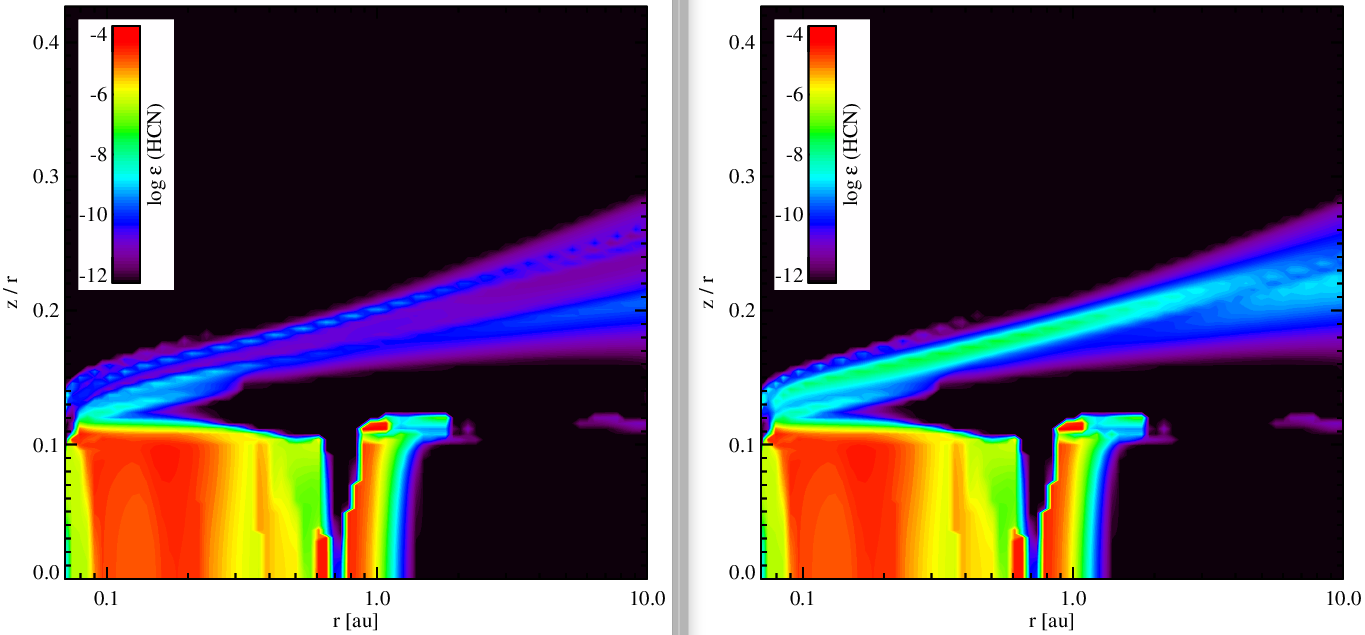
Switching on these options generally means that molecules like HCN and C2H2 can form higher up in the disk, but in less amounts, see figure (left is without, and right is with all three additional shielding options listed above).
Some more details and references about the shielding factors are given on these pages:
- how to run ProDiMo with CO_selfshielding_from_RT
- how to run models with N2_shielding
- how to use different formulae for the H2 self-shielding
Another important switch concerns the way we apply the shielding factors in 2D disk geometry. The general idea here is to split the mean intensity Jnu that causes the photorates into two parts, (i) the part Jnu_rad coming from direct radial irradiation by the star, and (ii) the part Jnu_ver coming from the vertical downward direction. The switch
.true. ! new_shielding : switch on the new 2D concept toggles between the old concept and new concept how to split up Jnu, where Jnu = Jnu_rad + Jnu_ver. In both cases
Jnu_eff = shield_rad * Jnu_rad + shield_ver * Jnu_veris applied when calculating the effective photorates after molecular shielding.
The old concept is to
- calculate Jnu_rad from the stellar flux, the solid angle of the star, and the radial continuum optical depth
- calculate the vertical irradiation from the interstellar background and the vertical continuum optical depth
- correct both by a factor to match Jnu as computed by the continuum radiative transfer
The new concept is to
- calculate Jnu_rad from the stellar flux, the solid angle of the star, and the radial continuum optical depth
- calculate the vertical part as Jnu_ver = Jnu - Jnu_rad
In the warm molecular layers, we often have the case that the UV is coming from above by scattering of stellar UV light on small dust grains. This part of Jnu is not considered in the old concept. According to the new concept we assume that the scattered light reaches the point of interest in the vertical downward direction, hence we apply the vertical molecular column densities.
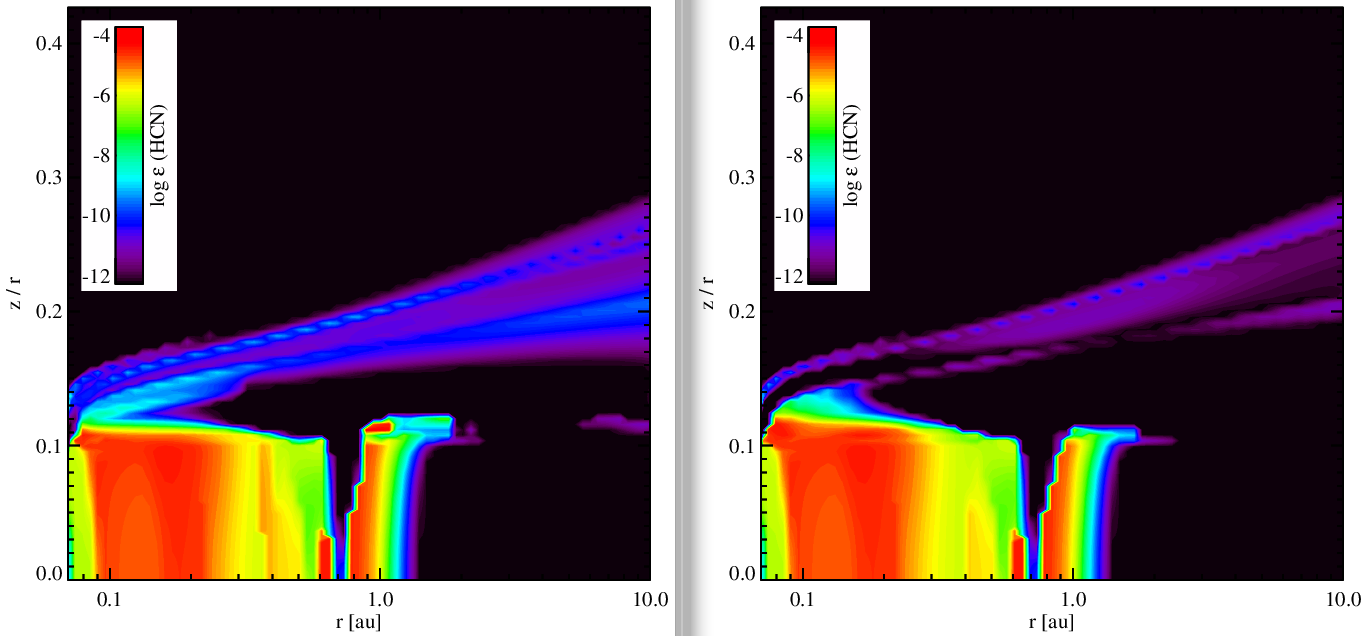
Models with new_shielding show strongly increased molecular densities in the warm molecular regions, see figure below. The reason is that vertical irradiation from the interstellar background is actually often quite small, hence the respective weight of the vertical direction for the shielding is too small according to the old concept. Hence, by applying mostly the radial shielding factors (where the molecular column densities are large) according to the old concept overestimates the molecular shielding. A few more results are shown in escpro.pdf. Consequently, when new_shielding=T, H2, CO and C form only deeper in the disk, where densities are larger, and that seems to favour the formation of molecules like HCN and C2H2.