Vertical hydrostatic equilibrium
In the following two setups are described to solve for the vertical hydrostatic equilibrium of the disk. In this mode global iterations are needed to reach convergence of the disk structure, in contrast to a fixed density structure fixed-density structure model.
To enable the hydrostatic disk structure mode use
.true.     ! solve_diskstruc   : solve the vertical hydrostatic eq.?
.false.    ! MCFOST_LIKE       : fixed disk structure like in MCFOST?
Furthermore still parameters such as the disk mass, power-law for the surface density and disk radii are required, see fixed-density structure.
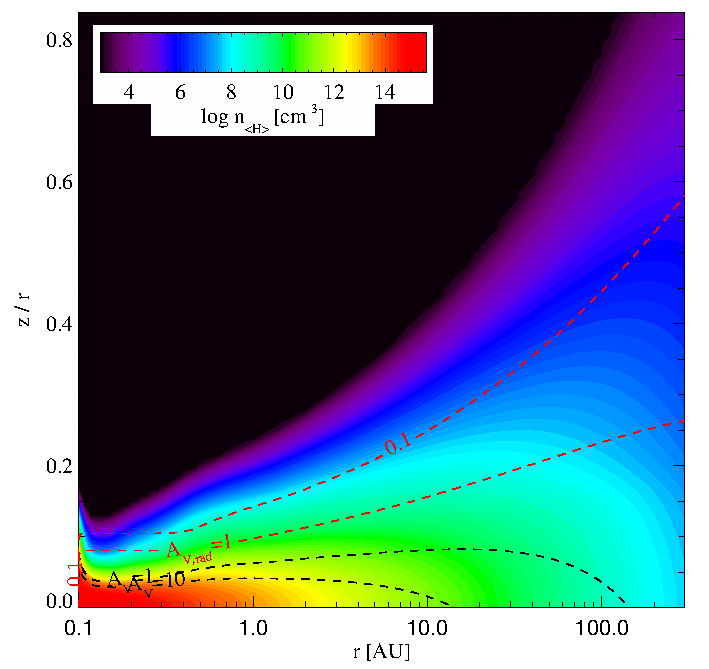
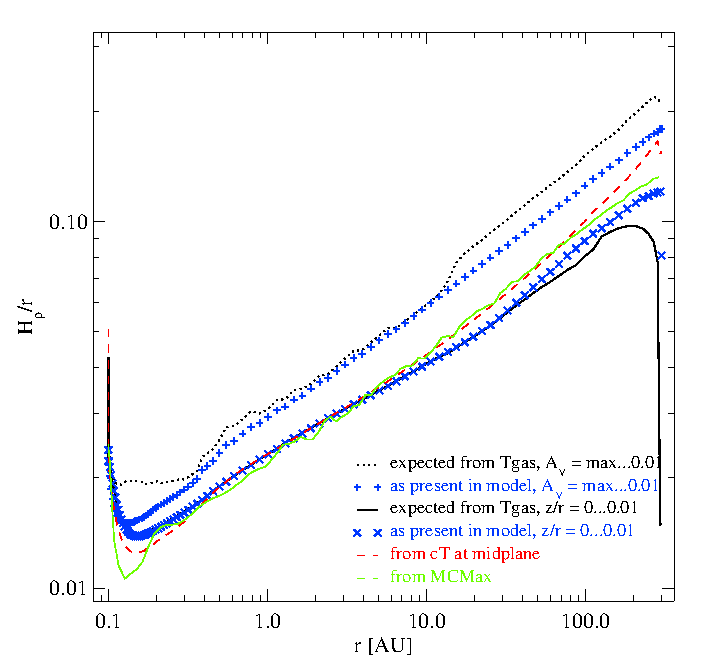
Hydrostatic disk structure from Tdust (MCMAX-like)
Use solve_diskstruc=.true. in combination with MCMAX_LIKE=.true. to solve for the vertical hydrostatic equilibrium, assuming
, i.e. assuming and a fixed mean molecular weight (-rich). Since is smooth (and is constant), this method still gives quite smooth and regular results, and the number of global structure iterations is quite small, about 5 to 10.
Hydrostatic disk structure from Tgas (most physical)
Use solve_diskstruc=.true. in combination with MCMAX_LIKE=.false..
One should always use
conserve_pressure=.true.for this mode!
In this case, the square of the isothermal sound speed
is taken from the calculated gas pressure, i.e. relying on the calculated gas temperatures and mean molecular weights. These models result in quite complicated disc structures, with a very high inner rim (2-3 times higher as compared to option 2) and intermittent "steps" related to sudden drops of the gas temperatures. Since can easily be 10 times larger than , and the mean molecular weight 2 times, or even 4 times, smaller than , these models are typically much more vertically extended, although the mid-plane regions are practically the same as with option 2. Because of all the partly unstable temperature jumps, these models are slow, needing about 30-100 structure iterations, depending of grid size.
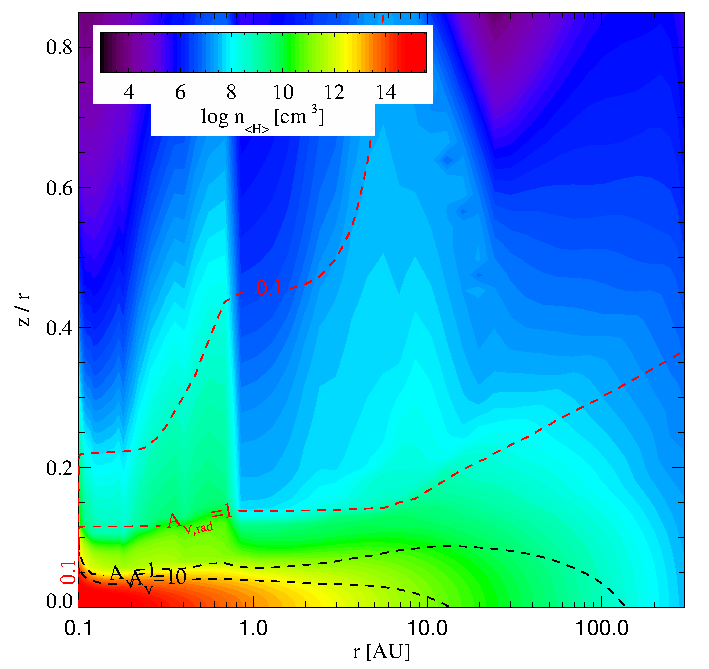
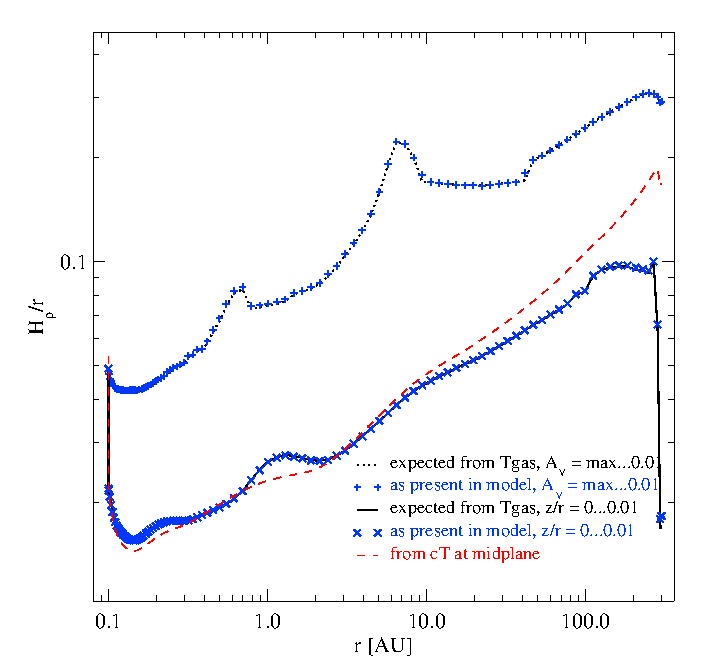
In the above l.h.s. pictures, the red dashed lines mark the radial and 1 (the disk flaring) and the black dashed lines show the vertical and 10. The r.h.s. figures show in blue the scale heights as present in the model. The crosses are related to the density difference between and , the plus marks are related to the density difference between and . Note the difference between them in the more physical models where is not constant.
All three models (including the fixed-density one) have been computed without dust settling (assuming well-mixed dust and gas), but you can combine all three options with dust settling.
Addition to hydrostatic structure convergence
There are two flags the user can set to change how fast the changes to the disk structure are made. When one notices that the vertical density structure oscillates, which can occur for disks that are external illuminated (proplyds) the vertical structure does not converge. One can set the damping value disk_structure_damp to a value higher than the default of 0.3 together with the threshold value to be set to 0.
0.8    ! disk_structure_damp : by default = 0.3
0.0    ! disk_structure_error_threshold : by default = 2.0
The changes between iterations become much slower but the structure will converge instead of oscillating between extremes.