Stellar properties
A ProDiMo disk model always requires a central light source, the star. Here we describe the options for setting stellar properties and the stellar spectrum.
Required parameters
The minium set of parameters for a star are the following:
---- star and irradiation ----
0.7         ! Mstar       [Msun]  : stellar mass
1.0         ! Lstar       [Lsun]  : stellar luminosity (photosphere)
4000.0      ! Teff        [K]     : stellar effective temperature
With those parameters the INIT_STAR section for the log file looks like this
...

 INIT_STAR: ...
 Teff  [K]    =  4000.0000
 Lstar [Lsun] =     1.0000
 Mstar [Msun] =     0.7000
 Rstar [Rsun] =     2.0862
 logg         =     3.6441
 Mdisk [Msun] =   1.00E-03 (3.33E+02 Mearth)
 R_in  [AU]   =     0.1500
 R_out [AU]   =   200.0000
 v(Rin)[km/s] =    64.3424
 P(Rin)[days] =    25.3621

 interpolating Phoenix stellar spectrum ...
read 8727 points from Phoenix_04000-3.5.dat  corr= 1.005
read 8727 points from Phoenix_04000-4.0.dat  corr= 1.001
read 8727 points from Phoenix_04100-3.5.dat  corr= 1.006
read 8727 points from Phoenix_04100-4.0.dat  corr= 1.001
 test integrated star spectrum    4000.0000000000000        3999.9428634742662
 ... having filled   176 lambda-gaps
 ...   751 additional points, altogether  9478
 Lstar =    1.0000   Ltotal =   0.9999   Ladded =  -0.0001
 fUV = -1.000000  L_UV/Lstar = 0.000001  Ladded/Lstar =-0.000057
 Teff from full Spectrum is    3999.9
 Lstar                                         = 3.846E+33 erg/s
 L_UV            between  91.20nm  - 250.00nm  = 2.069E+27 erg/s
 L_UV1           between  91.20nm  - 111.00nm  = 2.233E+16 erg/s
 L_UV2           between  91.20nm  - 205.00nm  = 1.888E+25 erg/s
 L_Lyalpha       between 118.57nm  - 124.57nm  = 2.525E+18 erg/s
 L_EUV           between  91.20nm  -   0.10keV = 1.119E+12 erg/s

 photon particle fluxes ...
 - UV band 1 (912-1110)Ang: 1.84520E+04 1/cm^2/s  (chi=8.764E-04)
 - UV band 2 (912-2050)Ang: 2.82701E+13 1/cm^2/s  (chi=1.471E+05)
 -    1000 Ang photon flux: 5.44983E-02 1/cm^2/s/(cm^-1)
 -    1000 Ang   lam*u_lam: 3.61110E-18 erg/cm^3
 -     stellar chi at 1 AU: 2.06404E-08 3.46524E+00
 - ISM irradiation (UV band 1) may dominate >  1.437E-04 AU

...
As the log outputs indicate, ProDiMo looks up PHOENIX (or Kurucz) stellar atmosphere models and interpolates on that grid, to derive the stellar spectrum (see Stellar Spectra).Please note that Lstar corresponds to just this photosphere spectrum (i.e. does not include X-rays or excess UV radiation).
The stellar radius and are not parameters but are given by and
If one wants to include the DRIFT-PHOENIX grid (cooler stars) one needs to set
.true. ! use_drift_phoenix : Include the DRIFT-PHOENIX atmosphere gridExcess UV (Accretion Luminosity)
As young stars are still accreting, they usually show some excess UV emission. There are two parameterized ways to include such an UV excess emission.
Power-law spectrum
To model the excess UV as a power-law spectrum use
0.01        ! fUV         [-]     : LUV/Lstar
1.3         ! pUV         [-]     : UV power-law exponent
where fUV represents the excess luminosity as fraction of Lstar and pUV the slope of the UV spectrum. ProDiMo then tries to connect this power-law spectrum to the stellar photosphere-spectrum (see Examples below).
Accretion Black-body
To use a black-body spectrum for the excess UV with a fixed temperature of T=10000 K and a given accretion luminosity Laccr just set
0.1 ! Lacc : accretion luminosity [Lsun], blackbody at T=10000KDifferently to the power-law case this black-body is added to the stellar photosphere spectrum.
We recommend to think about what UV spectrum you want to use, as it is most relevant for photo-chemistry, please also check UV photorates.
X-rays and EUV (Extreme-UV)
For how to include X-ray radiation and optionally also EUV radiation (see Examples) from the star see X-rays.
TODO: smoothEUV Parameter
TODO: maybe move the part on the X-ray input Spectrum to here
Custom StarSpectrum.in
Besides the parameterised options one can also provide a custom stellar input spectrum via an additional input file called StarSpectrum.in. In that case all the above described parameters for the stellar spectrum are ignored. This is in useful for e.g. modelling a particular target, where measurements for the UV-excess or X-ray spectrum exist. This was usually done for the DIANA Models and one can also use the starfit tool included in ProDiMo.
TODO: example on how to make a StarSpectrum.in by hand
TODO: X-ray spectrum can still be added parameterised.
Examples
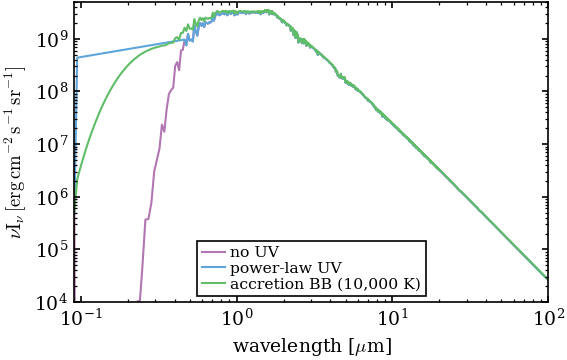
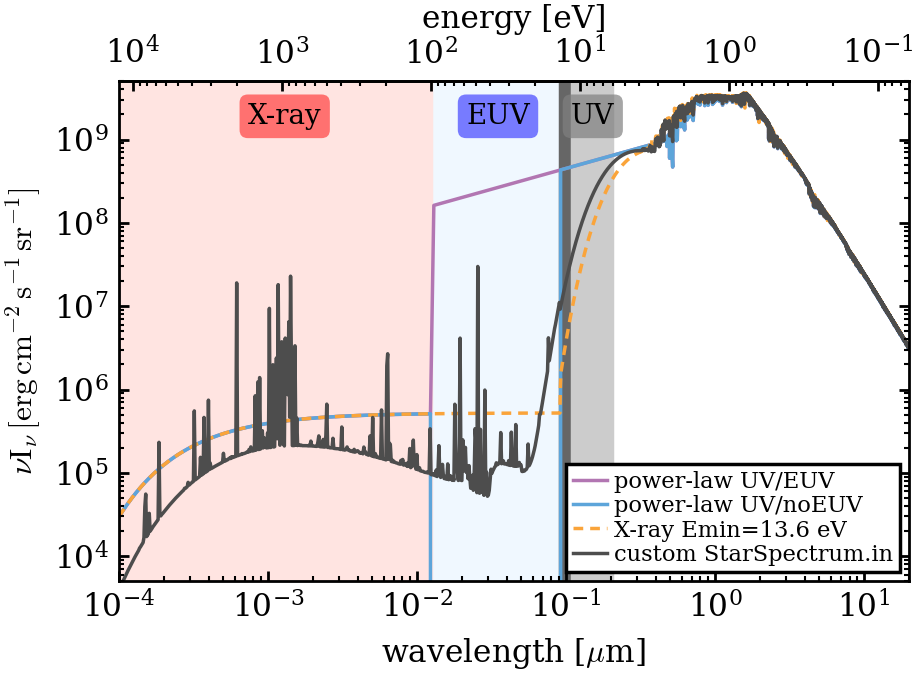
The left panel shows three different spectra, one without UV, one with power-law UV and one with a black-body UV. The right panel shows four spectra also including the X-ray and EUV range. The last one (black solid line) shows a spectrum using a custom StarSpectrum.in. Also indicated are the special wavelength regimes X-rays (red) EUV (blue) and UV (gray, dark gray is the UV band 1, see UV photorates).
Those spectra can be produced with these parameter settings (except the one with custom StarSpectrum.in)
---- star and irradiation ----
*** photosphere
0.7         ! Mstar       [Msun]  : stellar mass
1.436       ! Lstar       [Lsun]  : stellar luminosity
4000.0      ! Teff        [K]     : stellar effective temperature

---- UV excess ----
*** with power-law UV
0.122       ! fUV         [-]     : LUV/Lstar
-0.5        ! pUV         [-]     : UV power-law exponent

*** including EUV
.false.     ! noEUV               : include EUV range for chemistry TODO: behaviour is not clear

*** or accretion Blackbody
0.31        ! Lacc                : accretion luminosity [Lsun], blackbody at T=10000K

--- X-rays/EUV ---
1.33E+30    ! Xray_Lum    [erg/s] : X-ray luminosity
.true.      ! Xray_norm           :  normalize lum to 0.1-10 keV range
12.4        ! Xray_Emax           : X-ray max. photon energy
5.E+7       ! Xray_Temp   [K]     : X-ray emission temperature
*** Extending X-ray into the EUV range, required for Hatom, uses X-ray chemistry in the EUV range
0.0136      ! Xray_Emin   [keV]   : X-ray min. photon energy
We note that both UV spectra (accretion BB, or power-law) will give a mass-accretion rate onto the star of , using , where we defined (see also prodimopy DataStar).
Also the X-ray luminosity is the same for custom StarSpectrum.in and the other spectra.
TODO: explain the different regimes (X-rays, EUV, UV)
TODO: provide example for making a StarSpectrum.in
Further options
TODO: just use a blackbody
TODO: Include parameter for controlling the number of bands in the RT, check what is documented for the continuum RT and XrayRT, is actually discussed in UV photorates.